Showing posts with label Eliot T S. Show all posts

Thursday, December 15, 2022

The Journey of the Magi


“A cold coming we had of it,
Just the worst time of the year
For a journey, and such a long journey:
The ways deep and the weather sharp,
The very dead of winter.”
And the camels galled, sore-footed, refractory,
Lying down in the melting snow.
There were times we regretted
The summer palaces on slopes, the terraces,
And the silken girls bringing sherbet.
Then the camel men cursing and grumbling
and running away, and wanting their liquor and women,
And the night-fires going out, and the lack of shelters,
And the cities hostile and the towns unfriendly
And the villages dirty and charging high prices:
A hard time we had of it.
At the end we preferred to travel all night,
Sleeping in snatches,
With the voices singing in our ears, saying
That this was all folly.

Then at dawn we came down to a temperate valley,
Wet, below the snow line, smelling of vegetation;
With a running stream and a water-mill beating the darkness,
And three trees on the low sky,
And an old white horse galloped away in the meadow.
Then we came to a tavern with vine-leaves over the lintel,
Six hands at an open door dicing for pieces of silver,
And feet kicking the empty wine-skins.
But there was no information, and so we continued
And arriving at evening, not a moment too soon
Finding the place; it was (you might say) satisfactory.
All this was a long time ago, I remember,

And I would do it again, but set down
This set down
This: were we led all that way for
Birth or Death? There was a Birth, certainly
We had evidence and no doubt. I had seen birth and death,
But had thought they were different; this Birth was
Hard and bitter agony for us, like Death, our death.
We returned to our places, these Kingdoms,
But no longer at ease here, in the old dispensation,
With an alien people clutching their gods.
I should be glad of another death.

-- T. S. Eliot (1888-1965), American-born Modernist English poet, essayist, editor and critic

Friday, July 2, 2021

Chorus I from The Rock


I
The Eagle soars in the summit of Heaven,
The Hunter with his dogs pursues his circuit.
O perpetual revolution of configured stars,
O perpetual recurrence of determined seasons,
O world of spring and autumn, birth and dying!
The endless cycle of idea and action,
Endless invention, endless experiment,
Brings knowledge of motion, but not of stillness;
Knowledge of speech, but not of silence;
Knowledge of words, and ignorance of the Word.
All our knowledge brings us nearer to our ignorance,
All our ignorance brings us nearer to death,
But nearness to death no nearer to God .
Where is the Life we have lost in living?
Where is the wisdom we have lost in knowledge?
Where is the knowledge we have lost in information?
The cycles of Heaven in twenty centuries
Bring us farther from God and nearer to the Dust.

I journeyed to London, to the timekept City,
Where the River flows, with foreign flotations.
There I was told: we have too many churches,
And too few chop-houses. There I was told:
Let the vicars retire. Men do not need the Church
In the place where they work, but where they spend their Sundays.
In the City, we need no bells:
Let them waken the suburbs.
I journeyed to the suburbs, and there I was told:
We toil for six days, on the seventh we must motor
To Hindhead, or Maidenhead.
If the weather is foul we stay at home and read the papers.
In industrial districts, there I was told
Of economic laws.
In the pleasant countryside, there it seemed
That the country now is only fit for picnics.
And the Church does not seem to be wanted
In country or in suburb; and in the town
Only for important weddings.

CHORUS LEADER :

Silence! and preserve respectful distance.
For I perceive approaching
The Rock. Who will perhaps answer our doubtings.
The Rock. The Watcher. The Stranger.
He who has seen what has happened
And who sees what is to happen.
The Witness. The Critic. The Stranger.
The God-shaken, in whom is the truth inborn.

Enter the ROCK , led by a BOY :

THE ROCK :


The lot of man is ceaseless labour,
Or ceaseless idleness, which is still harder,
Or irregular labour, which is not pleasant.
I have trodden the winepress alone, and I know
That it is hard to be really useful, resigning
The things that men count for happiness, seeking
The good deeds that lead to obscurity, accepting
With equal face those that bring ignominy,
The applause of all or the love of none.
All men are ready to invest their money
But most expect dividends.
I say to you: Make perfect your will .
I say: take no thought of the harvest,
But only of proper sowing.

The world turns and the world changes,
But one thing does not change.
In all of my years, one thing does not change.
However you disguise it, this thing does not change:
The perpetual struggle of Good and Evil.
Forgetful, you neglect your shrines and churches;
The men you are in these times deride
What has been done of good, you find explanations
To satisfy the rational and enlightened mind.
Second, you neglect and belittle the desert.
The desert is not remote in southern tropics,
The desert is not only around the corner,
The desert is squeezed in the tube-train next to you,
The desert is in the heart of your brother.
The good man is the builder, if he build what is good.
I will show you the things that are now being done,
And some of the things that were long ago done,
That you may take heart. Make perfect your will.
Let me show you the work of the humble. Listen.

The lights fade; in the semi-darkness the voices of WORKMEN are heard chanting .

In the vacant places
We will build with new bricks
There are hands and machines
And clay for new brick
And lime for new mortar
Where the bricks are fallen
We will build with new stone
Where the beams are rotten
We will build with new timbers
Where the word is unspoken
We will build with new speech
There is work together
A Church for all
And a job for each
Every man to his work.

Now a group of WORKMEN is silhouetted against the dim sky. From farther away, they are answered by voices of the UNEMPLOYED .

No man has hired us
With pocketed hands
And lowered faces
We stand about in open places
And shiver in unlit rooms.
Only the wind moves
Over empty fields, untilled
Where the plough rests, at an angle
To the furrow. In this land
There shall be one cigarette to two men,
To two women one half pint of bitter
Ale. In this land
No man has hired us.
Our life is unwelcome, our death
Unmentioned in " The Times".

Chant of WORKMEN again .

The river flows, the seasons turn
The sparrow and starling have no time to waste.
If men do not build
How shall they live?
When the field is tilled
And the wheat is bread
They shall not die in a shortened bed
And a narrow sheet. In this street
There is no beginning, no movement, no peace and no end
But noise without speech, food without taste.
Without delay, without haste
We would build the beginning and the end of this street.
We build the meaning:
A Church for all
And a job for each
Each man to his work.

-- T. S. Eliot (1888-1965), Anglo-American Modernist poet and Nobel Prize winner in literature, from his play The Rock.

Image: Workers at La Sagrada Familia, Barcelona, 2015

Chorus III from The Rock


III

The Word of the LORD came unto me, saying:
O miserable cities of designing men,
O wretched generation of enlightened men,
Betrayed in the mazes of your ingenuities,
Sold by the proceeds of your proper inventions:
I have given you hands which you turn from worship,
I have given you speech, for endless palaver,
I have given you my Law, and you set up commissions,
I have given you lips, to express friendly sentiments,
I have given you hearts, for reciprocal distrust.
I have given you power of choice, and you only alternate
Between futile speculation and unconsidered action.

Many are engaged in writing books and printing them,
Many desire to see their names in print,
Many read nothing but the race reports.
Much is your reading, but not the Word of GOD ,
Much is your building, but not the House of GOD .
Will you build me a house of plaster, with corrugated roofing,
To be filled with a litter of Sunday newspapers?

1ST MALE VOICE :

A Cry from the East:
What shall be done to the shore of smoky ships?
Will you leave my people forgetful and forgotten
To idleness, labour, and delirious stupor?
There shall be left the broken chimney,
The peeled hull, a pile of rusty iron,
In a street of scattered brick where the goat climbs,
Where My Word is unspoken.

2ND MALE VOICE :

A Cry from the North, from the West and from the South
Whence thousands travel daily to the timekept City;
Where My Word is unspoken,
In the land of lobelias and tennis flannels
The rabbit shall burrow and the thorn revisit,
The nettle shall flourish on the gravel court,
And the wind shall say: " Here were decent godless people:
Their only monument the asphalt road
And a thousand lost golf balls".

CHORUS :

We build in vain unless the LORD build with us.
Can you keep the City that the LORD keeps not with you?
A thousand policemen directing the traffic
Cannot tell you why you come or where you go.
A colony of cavies or a horde of active marmots
Build better than they that build without the LORD .
Shall we lift up our feet among perpetual ruins?
I have loved the beauty of Thy House, the peace of Thy sanctuary
I have swept the floors and garnished the altars.
Where there is no temple there shall be no homes,
Though you have shelters and institutions,
Precarious lodgings while the rent is paid,
Subsiding basements where the rat breeds
Or sanitary dwellings with numbered doors
Or a house a little better than your neighbour's;
When the Stranger says: " What is the meaning of this city?
Do you huddle close together because you love each other?"
What will you answer? " We all dwell together
To make money from each other"? or " This is a community"?
And the Stranger will depart and return to the desert.

O my soul, be prepared for the coming of the Stranger,
Be prepared for him who knows how to ask questions.

O weariness of men who turn from GOD
To the grandeur of your mind and the glory of your action,
To arts and inventions and daring enterprises,
To schemes of human greatness thoroughly discredited,
Binding the earth and the water to your service,
Exploiting the seas and developing the mountains,
Dividing the stars into common and preferred,
Engaged in devising the perfect refrigerator,
Engaged in working out a rational morality,
Engaged in printing as many books as possible,
Plotting of happiness and flinging empty bottles,
Turning from your vacancy to fevered enthusiasm
For nation or race or what you call humanity;
Though you forget the way to the Temple,
There is one who remembers the way to your door:
Life you may evade, but Death you shall not.
You shall not deny the Stranger.

-- T. S. Eliot (1888-1965), Anglo-American Modernist poet and Nobel Prize winner in literature, from his play The Rock.

Image: Workers at La Sagrada Familia, Barcelona, 2015

Chorus IV from The Rock


IV 

There are those who would build the Temple,
And those who prefer that the Temple should not be built.
In the days of Nehemiah the Prophet
There was no exception to the general rule.
In Shushan the palace, in the month Nisan,
He served the wine to the king Artaxerxes,
And he grieved for the broken city, Jerusalem;
And the King gave him leave to depart
That he might rebuild the city.
So he went, with a few, to Jerusalem,
And there, by the dragon's well, by the dung gate,
By the fountain gate, by the king's pool,
Jerusalem lay waste, consumed with fire;
No place for a beast to pass.
There were enemies without to destroy him,
And spies and self-seekers within,
When he and his men laid their hands to rebuilding the wall
So they built as men must build
With the sword in one hand and the trowel in the other.

-- T. S. Eliot (1888-1965), Anglo-American Modernist poet and Nobel Prize winner in literature, from his play The Rock.

Image: Exterior of La Sagrada Familia, Barcelona, 2015

Chorus V from The Rock


O Lord, deliver me from the man of excellent intention and impure heart: for the heart is deceitful above all things, and desperately wicked.
Sanballat the Horonite and Tobiah the Ammonite and Geshem the Arabian: were doubtless men of public spirit and zeal.
Preserve me from the enemy who has something to gain: and from the friend who has something to lose.
Remembering the words of Nehemiah the Prophet: " The trowel in hand, and the gun rather loose in the holster."
Those who sit in a house of which the use is forgotten: are like snakes that lie on mouldering stairs, content in the sun light.
And the others run about like dogs, full of enterprise, sniffing and barking: they say, " This house is a nest of serpents, let us destroy it,
And have done with these abominations, the turpitudes of the Christians." And these are not justified, nor the others.
And they write innumerable books; being too vain and distracted for silence: seeking every one after his own elevation, and dodging his emptiness.
If humility and purity be not in the heart, they are not in the home: and if they are not in the home, they are not in the City.
The man who has builded during the day would return to his hearth at nightfall: to be blessed with the gift of silence, and doze before he sleeps.
But we are encompassed with snakes and dogs: therefore some must labour, and others must hold the spears.

-- T. S. Eliot (1888-1965), Anglo-American Modernist poet and Nobel Prize winner in literature, from his play The Rock.


Image: Detail from the Passion side exterior at La Sagrada Familia, Barcelona, 2015

Chorus VI from The Rock


VI
 
It is hard for those who have never known persecution,
And who have never known a Christian,
To believe these tales of Christian persecution.
It is hard for those who live near a Bank
To doubt the security of their money.
It is hard for those who live near a Police Station
To believe in the triumph of violence.
Do you think that the Faith has conquered the World
And that lions no longer need keepers?
Do you need to be told that whatever has been, can still be?
Do you need to be told that even such modest attainments
As you can boast in the way of polite society
Will hardly survive the Faith to which they owe their significance?
Men! polish your teeth on rising and retiring;
Women! polish your fingernails:
You polish the tooth of the dog and the talon of the cat.
Why should men love the Church? Why should they love her laws?
She tells them of Life and Death, and of all that they would forget.
She is tender where they would be hard, and hard where they like to be soft.
She tells them of Evil and Sin, and other unpleasant facts.
They constantly try to escape
From the darkness outside and within
By dreaming of systems so perfect that no one will need to be good.
But the man that is will shadow
The man that pretends to be.
And the Son of Man was not crucified once for all,
The blood of the martyrs not shed once for all,
The lives of the Saints not given once for all:
But the Son of Man is crucified always
And there shall be Martyrs and Saints.
And if blood of Martyrs is to flow on the steps
We must first build the steps;
And if the Temple is to be cast down
We must first build the Temple.

-- T. S. Eliot (1888-1965), Anglo-American Modernist poet and Nobel Prize winner in literature, from his play The Rock.


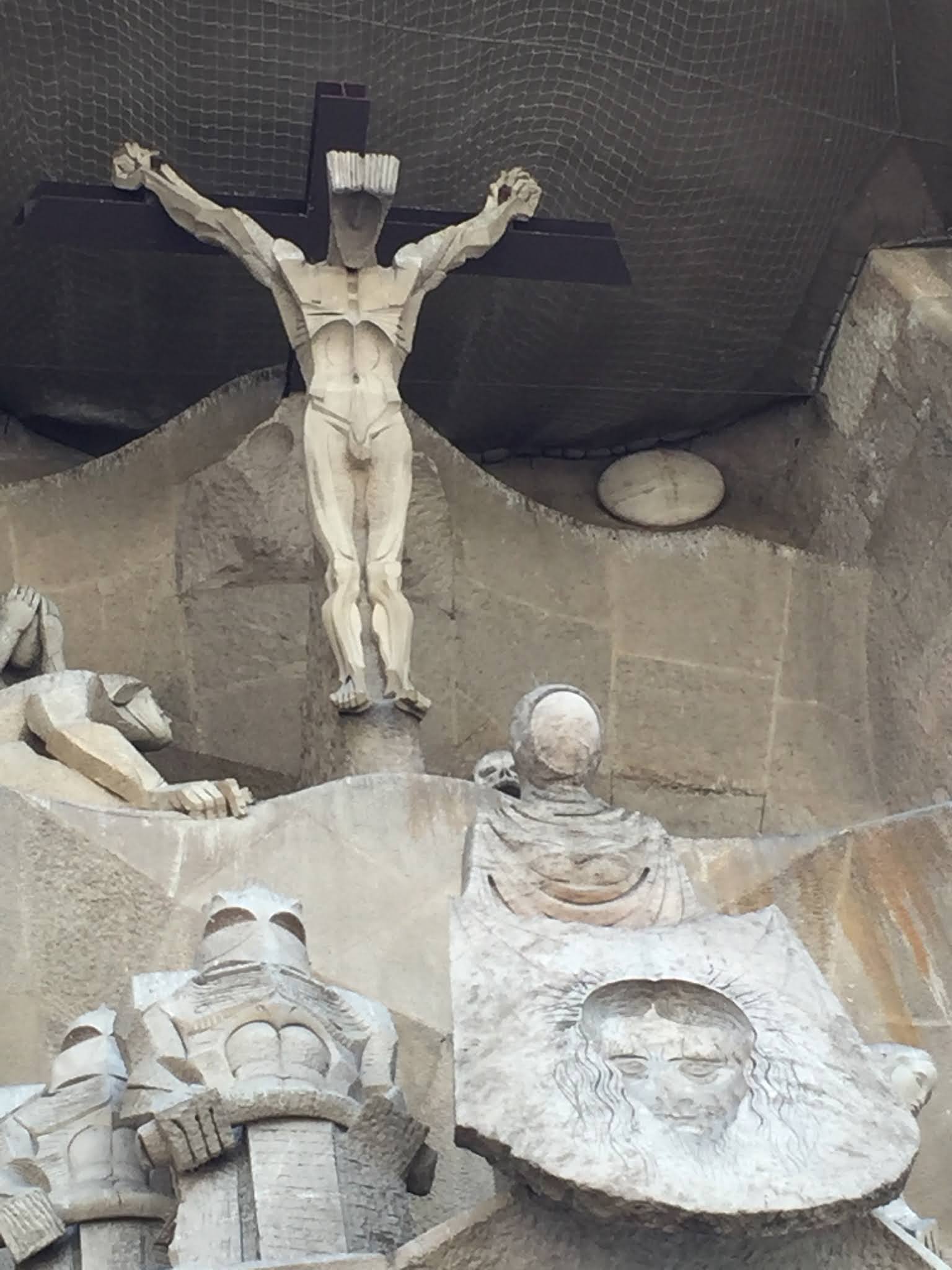
Image: Crucifixion at La Sagrada Familia, Barcelona, 2015

Chorus VII from The Rock


VII

In the beginning GOD created the world. Waste and void. Waste and void. And darkness was upon the face of the deep.
And when there were men, in their various ways, they struggled in torment towards GOD
Blindly and vainly, for man is a vain thing, and man without GOD is a seed upon the wind: driven this way and that, and finding no place of lodgement and germination.
They followed the light and the shadow, and the light led them forward to light and the shadow led them to darkness,
Worshipping snakes or trees, worshipping devils rather than nothing: crying for life beyond life, for ecstasy not of the flesh.
Waste and void. Waste and void. And darkness on the face of the deep.
And the Spirit moved upon the face of the water.
And men who turned towards the light and were known of the light
Invented the Higher Religions; and the Higher Religions were good
And led men from light to light, to knowledge of Good and Evil.
But their light was ever surrounded and shot with darkness
As the air of temperate seas is pierced by the still dead breath of the Arctic Current;
And they came to an end, a dead end stirred with a flicker of life,
And they came to the withered ancient look of a child that has died of starvation.
Prayer wheels, worship of the dead, denial of this world, affirmation of rites with forgotten meanings
In the restless wind-whipped sand, or the hills where the wind will not let the snow rest.
Waste and void. Waste and void. And darkness on the face of the deep.

Then came, at a predetermined moment, a moment in time and of time,
A moment not out of time, but in time, in what we call history: transecting, bisecting the world of time, a moment in time but not like a moment of time,
A moment in time but time was made through that moment: for without the meaning there is no time, and that moment of time gave the meaning.
Then it seemed as if men must proceed from light to light, in the light of the Word,
Through the Passion and Sacrifice saved in spite of their negative being;
Bestial as always before, carnal, self-seeking as always before, selfish and purblind as ever before,
Yet always struggling, always reaffirming, always resuming their march on the way that was lit by the light;
Often halting, loitering, straying, delaying, returning, yet following no other way.

But it seems that something has happened that has never happened before: though we know not just when, or why, or how, or where.
Men have left GOD not for other gods, they say, but for no god; and this has never happened before
That men both deny gods and worship gods, professing first Reason,
And then Money, and Power, and what they call Life, or Race, or Dialectic.
The Church disowned, the tower overthrown, the bells upturned, what have we to do
But stand with empty hands and palms turned upwards
In an age which advances progressively backwards?

VOICE OF THE UNEMPLOYED ( afar off ):

In this land

There shall be one cigarette to two men,
To two women one half pint of bitter
Ale. . . .

CHORUS :

What does the world say, does the whole world stray in high-powered cars on a by-pass way?

VOICE OF THE UNEMPLOYED ( more faintly ):

In this land

No man has hired us. . . .

CHORUS :

Waste and void. Waste and void. And darkness on the face of the deep.
Has the Church failed mankind, or has mankind failed the Church?
When the Church is no longer regarded, not even opposed, and men have forgotten
All gods except Usury, Lust and Power.


--T. S. Eliot (1888-1965), Anglo-American Modernist poet and Nobel Prize winner in literature, from his play The Rock.


Image: Detail from Passion exterior at La Sagrada Familia, Barcelona, 2015

Chorus VIII from The Rock


VIII 

O Father we welcome your words,
And we will take heart for the future,
Remembering the past.

The heathen are come into thine inheritance,
And thy temple have they defiled.

Who is this that cometh from Edom?

He has trodden the wine-press alone.

There came one who spoke of the shame of Jerusalem
And the holy places defiled;
Peter the Hermit, scourging with words.
And among his hearers were a few good men,
Many who were evil,
And most who were neither.
Like all men in all places,

Some went from love of glory,
Some went who were restless and curious,
Some were rapacious and lustful.
Many left their bodies to the kites of Syria
Or sea-strewn along the routes;
Many left their souls in Syria,
Living on, sunken in moral corruption;
Many came back well broken,
Diseased and beggared, finding
A stranger at the door in possession:
Came home cracked by the sun of the East
And the seven deadly sins in Syria.
But our King did well at Acre.
And in spite of all the dishonour,
The broken standards, the broken lives,
The broken faith in one place or another,
There was something left that was more than the tales
Of old men on winter evenings.
Only the faith could have done what was good of it;
Whole faith of a few,
Part faith of many.
Not avarice, lechery, treachery,
Envy, sloth, gluttony, jealousy, pride:
It was not these that made the Crusades,
But these that unmade them.

Remember the faith that took men from home
At the call of a wandering preacher.
Our age is an age of moderate virtue
And of moderate vice
When men will not lay down the Cross
Because they will never assume it.
Yet nothing is impossible, nothing,
To men of faith and conviction.
Let us therefore make perfect our will.
O GOD , help us.

-- T. S. Eliot (1888-1965), Anglo-American Modernist poet and Nobel Prize winner in literature, from his play The Rock.


Image: Workers at La Sagrada Familia, Barcelona, 2015

Chorus IX from The Rock


IX
Son of Man, behold with thine eyes, and hear with thine ears
And set thine heart upon all that I show thee.
Who is this that has said: the House of GOD is a House of Sorrow;
We must walk in black and go sadly, with longdrawn faces,
We must go between empty walls, quavering lowly, whispering faintly,
Among a few flickering scattered lights?
They would put upon GOD their own sorrow, the grief they should feel
For their sins and faults as they go about their daily occasions.
Yet they walk in the street proudnecked, like thoroughbreds ready for races,
Adorning themselves, and busy in the market, the forum,
And all other secular meetings.
Thinking good of themselves, ready for any festivity,
Doing themselves very well.
Let us mourn in a private chamber, learning the way of penitence,
And then let us learn the joyful communion of saints.

The soul of Man must quicken to creation.
Out of the formless stone, when the artist united himself with stone,
Spring always new forms of life, from the soul of man that is joined to the soul of stone;
Out of the meaningless practical shapes of all that is living or lifeless
Joined with the artist's eye, new life, new form, new colour.
Out of the sea of sound the life of music,
Out of the slimy mud of words, out of the sleet and hail of verbal imprecisions,
Approximate thoughts and feelings, words that have taken the place of thoughts and feelings,
There spring the perfect order of speech, and the beauty of incantation.

LORD , shall we not bring these gifts to Your service?
Shall we not bring to Your service all our powers
For life, for dignity, grace and order,
And intellectual pleasures of the senses?
The LORD who created must wish us to create
And employ our creation again in His service
Which is already His service in creating.
For Man is joined spirit and body,
And therefore must serve as spirit and body.
Visible and invisible, two worlds meet in Man;
Visible and invisible must meet in His Temple;
You must not deny the body.

Now you shall see the Temple completed:
After much striving, after many obstacles;
For the work of creation is never without travail;
The formed stone, the visible crucifix,
The dressed altar, the lifting light,

Light

Light

The visible reminder of Invisible Light.


-- T. S. Eliot (1888-1965), Anglo-American Modernist poet and Nobel Prize winner in literature, from his play The Rock.


Image: Detail from a door at La Sagrada Familia, Barcelona, 2015

Chorus X from The Rock


X
You have seen the house built, you have seen it adorned
By one who came in the night, it is now dedicated to GOD .
It is now a visible church, one more light set on a hill
In a world confused and dark and disturbed by portents of fear.
And what shall we say of the future? Is one church all we can build?
Or shall the Visible Church go on to conquer the World?

The great snake lies ever half awake, at the bottom of the pit of the world, curled
In folds of himself until he awakens in hunger and moving his head to right and to left prepares for his hour to devour.
But the Mystery of Iniquity is a pit too deep for mortal eyes to plumb. Come
Ye out from among those who prize the serpent's golden eyes,
The worshippers, self-given sacrifice of the snake. Take
Your way and be ye separate.
Be not too curious of Good and Evil;
Seek not to count the future waves of Time;
But be ye satisfied that you have light
Enough to take your step and find your foothold.

O Light Invisible, we praise Thee!
Too bright for mortal vision.
O Greater Light, we praise Thee for the less;
The eastern light our spires touch at morning,
The light that slants upon our western doors at evening,
The twilight over stagnant pools at batflight,
Moon light and star light, owl and moth light,
Glow-worm glowlight on a grassblade.
O Light Invisible, we worship Thee!

We thank Thee for the lights that we have kindled,
The light of altar and of sanctuary;
Small lights of those who meditate at midnight
And lights directed through the coloured panes of windows
And light reflected from the polished stone,
The gilded carven wood, the coloured fresco.
Our gaze is submarine, our eyes look upward
And see the light that fractures through unquiet water.
We see the light but see not whence it comes.
O Light Invisible, we glorify Thee!

In our rhythm of earthly life we tire of light. We are glad when the day ends, when the play ends; and ecstasy is too much pain.
We are children quickly tired: children who are up in the night and fall asleep as the rocket is fired; and the day is long for work or play.
We tire of distraction or concentration, we sleep and are glad to sleep,
Controlled by the rhythm of blood and the day and the night and the seasons.
And we must extinguish the candle, put out the light and relight it;
Forever must quench, forever relight the flame.
Therefore we thank Thee for our little light, that is dappled with shadow.
We thank Thee who hast moved us to building, to finding, to forming at the ends of our fingers and beams of our eyes.
And when we have built an altar to the Invisible Light, we may set thereon the little lights for which our bodily vision is made.
And we thank Thee that darkness reminds us of light.
O Light Invisible, we give Thee thanks for Thy great glory!


-- T. S. Eliot (1888-1965), Anglo-American Modernist poet and Nobel Prize winner in literature, from his play The Rock.

Image: Judas Kiss, detail from the exterior of La Sagrada Familia, Barcelona, 2015

Saturday, April 3, 2021

Excerpt from "Little Gidding" for Holy Saturday


What we call the beginning is often the end

And to make an end is to make a beginning.
The end is where we start from. And every phrase
And sentence that is right (where every word is at home,
Taking its place to support the others,
The word neither diffident nor ostentatious,
An easy commerce of the old and the new,
The common word exact without vulgarity,
The formal word precise but not pedantic,
The complete consort dancing together)
Every phrase and every sentence is an end and a beginning,
Every poem an epitaph. And any action
Is a step to the block, to the fire, down the sea’s throat
Or to an illegible stone: and that is where we start.
We die with the dying:
See, they depart, and we go with them.
We are born with the dead:
See, they return, and bring us with them.
The moment of the rose and the moment of the yew-tree
Are of equal duration. A people without history
Is not redeemed from time, for history is a pattern
Of timeless moments. So, while the light fails
On a winter’s afternoon, in a secluded chapel
History is now and England.

With the drawing of this Love and the voice of this Calling

We shall not cease from exploration
And the end of all our exploring
Will be to arrive where we started
And know the place for the first time.
Through the unknown, unremembered gate
When the last of earth left to discover
Is that which was the beginning;
At the source of the longest river
The voice of the hidden waterfall
And the children in the apple-tree
Not known, because not looked for
But heard, half-heard, in the stillness
Between two waves of the sea.
Quick now, here, now, always—
A condition of complete simplicity
(Costing not less than everything)
And all shall be well and
All manner of thing shall be well
When the tongues of flame are in-folded
Into the crowned knot of fire
And the fire and the rose are one.


--T. S. Eliot (1888-1965), from "Little Gidding"

Tuesday, April 14, 2020

East Coker (From "The Four Quartets)


I.

In my beginning is my end. In succession
Houses rise and fall, crumble, are extended,
Are removed, destroyed, restored, or in their place
Is an open field, or a factory, or a by-pass.
Old stone to new building, old timber to new fires,
Old fires to ashes, and ashes to the earth
Which is already flesh, fur, and faeces,
Bone of man and beast, cornstalk and leaf.
Houses live and die: there is a time for building
And a time for living and for generation
And a time for the wind to break the loosened pane
And to shake the wainscot where the field mouse trots
And to shake the tattered arras woven with a silent motto.

  In my beginning is my end.  Now the light falls
Across the open field, leaving the deep lane 
Shuttered with branches, dark in the afternoon,
Where you lean against a bank while a van passes,
And the deep lane insists on the direction 
Into the village, in the electric heat
Hypnotized. In a warm haze the sultry light
Is absorbed, not reflected, by grey stone.
The dahlias sleep in the empty silence.
Wait for the early owl.
                       In that open field
If you do not come too close, if you do not come too close,
On a summer midnight, you can hear the music 
Of the weak pipe and the little drum
And see them dancing around the bonfire
The association of man and woman 
In daunsinge, signifying matrimonie—
A dignified and commodiois sacrament.
Two and two, necessarye coniunction,
Holding eche other by the hand or the arm
Whiche betokeneth concorde. Round and round the fire
Leaping through the flames, or joined in circles,
Rustically solemn or in rustic laughter
Lifting heavy feet in clumsy shoes,
Earth feet, loam feet, lifted in country mirth
Mirth of those long since under earth
Nourishing the corn. Keeping time,
Keeping the rhythm in their dancing
As in their living in the living seasons
The time of the seasons and the constellations
The time of milking and the time of harvest
The time of the coupling of man and woman
And that of beasts.  Feet rising and falling.
Eating and drinking.  Dung and death.
  Dawn points, and another day
Prepares for heat and silence. Out at sea the dawn wind
Wrinkles and slides. I am here
Or there, or elsewhere. In my beginning.


II.

What is the late November doing
With the disturbance of the spring
And creatures of the summer heat,
And snowdrops writhing under feet
And hollyhocks that aim too high
Red into grey and tumble down
Late roses filled with early snow?
Thunder rolled by the rolling stars
Simulates triumphal cars
Deployed in constellated wars
Scorpion fights against the sun
Until the Sun and Moon go down
Comets weep and Leonids fly
Hunt the heavens and the plains
Whirled in a vortex that shall bring
The world to that destructive fire
Which burns before the ice-cap reigns

  That was a way of putting it—not very satisfactory
A periphrastic study in a worn-out poetical fashion,
Leaving one still with the intolerable wrestle 
With words and meanings. The poetry does not matter
It was not (to start again) what one had expected.
What was to be the value of the long looked forward to,
Long hope for calm, the autumnal serenity 
And the wisdom of age? Had they deceived us 
Or deceived themselves, the quiet-voiced elders,
bequeathing us merely a receipt for deceit?
The serenity only a deliberate hebitude,
The wisdom only the knowledge of dead secrets
Useless in the darkness into which they peered
Or from which they turned their eyes. There is, it seems to us,
At best, only a limited value
In the knowledge derived from experience.
The knowledge imposes a pattern, and falsifies,
For the pattern is new in every moment
And every moment is a new and shocking
Valuation of all we have been. We are only undeceived
Of that which, deceiving, could no longer harm.
In the middle, not only in the middle of the way
But all the way, in a dark wood, in a bramble,
On the edge of a grimpen, where is no secure foothold,
And menaced by monsters, fancy lights,
Risking enchantment. Do not let me hear
Of the wisdom of old men, but rather of their folly,
Their fear of fear and frenzy, their fear of possession,
Of belonging to another, or to others, or to God.
The only wisdom we can hope to acquire 
Is the wisdom of humility: humility is endless.

  The houses are all gone under the sea.

  The dancers are all gone under the hill.


III.

O dark dark dark. They all go into the dark,
The vacant interstellar spaces, the vacant into the vacant,
The captains, merchant bankers, eminent men of letters,
The generous patrons of art, the statesmen and the rulers,
Distinguished civil servants, chairmen of many committees,
Industrial lords and petty contractors, all go into the dark,
And dark the Sun and Moon, and the Almanach de Gotha
And the Stock Exchange Gazette, the Directory of Directors,
And cold the sense and lost the motive of action.
And we all go with them, into the silent funeral,
Nobody's funeral, for there is no one to bury.
I said to my soul, be still, and let the dark come upon you
Which shall be the darkness of God. As, in a theatre, 
The lights are extinguished, for the scene to be changed
With a hollow rumble of wings, with a movement of darkness on darkness,
And we know that the hills and the trees, the distant panorama
And the bold imposing facade are all being rolled away—
Or as, when an underground train, in the tube, stops too long between stations
And the conversation rises and slowly fades into silence
And you see behind every face the mental emptiness deepen
Leaving only the growing terror of nothing to think about;
Or when, under ether, the mind is conscious but conscious of nothing—
I said to my soul, be still, and wait without hope
For hope would be hope for the wrong thing; wait without love
For love would be love of the wrong thing; there is yet faith
But the faith and the love and the hope are all in the waiting.
Wait without thought, for you are not ready for thought:
So the darkness shall be the light, and the stillness the dancing.
Whisper of running streams, and winter lightning.
The wild thyme unseen and the wild strawberry,
The laughter in the garden, echoed ecstasy
Not lost, but requiring, pointing to the agony 
Of death and birth.

                         You say I am repeating
Something I have said before. I shall say it again,
Shall I say it again? In order to arrive there,
To arrive where you are, to get from where you are not,
  You must go by a way wherein there is no ecstasy.
In order to arrive at what you do not know
  You must go by a way which is the way of ignorance.
In order to possess what you do not possess
  You must go by the way of dispossession.
In order to arrive at what you are not
  You must go through the way in which you are not.
And what you do not know is the only thing you know
And what you own is what you do not own
And where you are is where you are not.


IV.

The wounded surgeon plies the steel
That questions the distempered part;
Beneath the bleeding hands we feel
The sharp compassion of the healer's art
Resolving the enigma of the fever chart.

  Our only health is the disease
If we obey the dying nurse
Whose constant care is not to please
But to remind of our, and Adam's curse,
And that, to be restored, our sickness must grow worse.

  The whole earth is our hospital
Endowed by the ruined millionaire,
Wherein, if we do well, we shall
Die of the absolute paternal care
That will not leave us, but prevents us everywhere.

  The chill ascends from feet to knees,
The fever sings in mental wires.
If to be warmed, then I must freeze
And quake in frigid purgatorial fires
Of which the flame is roses, and the smoke is briars.

  The dripping blood our only drink,
The bloody flesh our only food:
In spite of which we like to think
That we are sound, substantial flesh and blood—
Again, in spite of that, we call this Friday good.


V.

So here I am, in the middle way, having had twenty years—
Twenty years largely wasted, the years of l'entre deux guerres
Trying to learn to use words, and every attempt 
Is a wholly new start, and a different kind of failure
Because one has only learnt to get the better of words
For the thing one no longer has to say, or the way in which
One is no longer disposed to say it. And so each venture
Is a new beginning, a raid on the inarticulate
With shabby equipment always deteriorating
In the general mess of imprecision of feeling,
Undisciplined squads of emotion. And what there is to conquer
By strength and submission, has already been discovered
Once or twice, or several times, by men whom one cannot hope
To emulate—but there is no competition—
There is only the fight to recover what has been lost
And found and lost again and again: and now, under conditions
That seem unpropitious. But perhaps neither gain nor loss.
For us, there is only the trying. The rest is not our business.

  Home is where one starts from. As we grow older
The world becomes stranger, the pattern more complicated
Of dead and living. Not the intense moment 
Isolated, with no before and after,
But a lifetime burning in every moment
And not the lifetime of one man only
But of old stones that cannot be deciphered.
There is a time for the evening under starlight,
A time for the evening under lamplight
(The evening with the photograph album).
Love is most nearly itself
When here and now cease to matter.

Old men ought to be explorers
Here and there does not matter
We must be still and still moving
Into another intensity
For a further union, a deeper communion
Through the dark cold and empty desolation,
The wave cry, the wind cry, the vast waters
Of the petrel and the porpoise. In my end is my beginning.

-- T. S. Eliot (1888-1965), Anglo-American poet, essayist, and playwright 

Thursday, April 2, 2020

The Waste Land


                                  FOR EZRA POUND
                                IL MIGLIOR FABBRO
              I. The Burial of the Dead

  April is the cruellest month, breeding
Lilacs out of the dead land, mixing
Memory and desire, stirring
Dull roots with spring rain.
Winter kept us warm, covering
Earth in forgetful snow, feeding
A little life with dried tubers.
Summer surprised us, coming over the Starnbergersee
With a shower of rain; we stopped in the colonnade,
And went on in sunlight, into the Hofgarten,
And drank coffee, and talked for an hour.
Bin gar keine Russin, stamm’ aus Litauen, echt deutsch.
And when we were children, staying at the arch-duke’s,
My cousin’s, he took me out on a sled,
And I was frightened. He said, Marie,
Marie, hold on tight. And down we went.
In the mountains, there you feel free.
I read, much of the night, and go south in the winter.

  What are the roots that clutch, what branches grow
Out of this stony rubbish? Son of man,
You cannot say, or guess, for you know only
A heap of broken images, where the sun beats,
And the dead tree gives no shelter, the cricket no relief,
And the dry stone no sound of water. Only
There is shadow under this red rock,
(Come in under the shadow of this red rock),
And I will show you something different from either
Your shadow at morning striding behind you
Or your shadow at evening rising to meet you;
I will show you fear in a handful of dust.
                      Frisch weht der Wind
                      Der Heimat zu
                      Mein Irisch Kind,
                      Wo weilest du?
“You gave me hyacinths first a year ago;
“They called me the hyacinth girl.”
—Yet when we came back, late, from the Hyacinth garden,
Your arms full, and your hair wet, I could not
Speak, and my eyes failed, I was neither
Living nor dead, and I knew nothing,
Looking into the heart of light, the silence.
Oed’ und leer das Meer.

  Madame Sosostris, famous clairvoyante,
Had a bad cold, nevertheless
Is known to be the wisest woman in Europe,
With a wicked pack of cards. Here, said she,
Is your card, the drowned Phoenician Sailor,
(Those are pearls that were his eyes. Look!)
Here is Belladonna, the Lady of the Rocks,
The lady of situations.
Here is the man with three staves, and here the Wheel,
And here is the one-eyed merchant, and this card,
Which is blank, is something he carries on his back,
Which I am forbidden to see. I do not find
The Hanged Man. Fear death by water.
I see crowds of people, walking round in a ring.
Thank you. If you see dear Mrs. Equitone,
Tell her I bring the horoscope myself:
One must be so careful these days.

  Unreal City,
Under the brown fog of a winter dawn,
A crowd flowed over London Bridge, so many,
I had not thought death had undone so many.
Sighs, short and infrequent, were exhaled,
And each man fixed his eyes before his feet.
Flowed up the hill and down King William Street,
To where Saint Mary Woolnoth kept the hours
With a dead sound on the final stroke of nine.
There I saw one I knew, and stopped him, crying: “Stetson!
“You who were with me in the ships at Mylae!
“That corpse you planted last year in your garden,
“Has it begun to sprout? Will it bloom this year?
“Or has the sudden frost disturbed its bed?
“Oh keep the Dog far hence, that’s friend to men,
“Or with his nails he’ll dig it up again!
“You! hypocrite lecteur!—mon semblable,—mon frère!”


              II. A Game of Chess

The Chair she sat in, like a burnished throne,
Glowed on the marble, where the glass
Held up by standards wrought with fruited vines
From which a golden Cupidon peeped out
(Another hid his eyes behind his wing)
Doubled the flames of sevenbranched candelabra
Reflecting light upon the table as
The glitter of her jewels rose to meet it,
From satin cases poured in rich profusion;
In vials of ivory and coloured glass
Unstoppered, lurked her strange synthetic perfumes,
Unguent, powdered, or liquid—troubled, confused
And drowned the sense in odours; stirred by the air
That freshened from the window, these ascended
In fattening the prolonged candle-flames,
Flung their smoke into the laquearia,
Stirring the pattern on the coffered ceiling.
Huge sea-wood fed with copper
Burned green and orange, framed by the coloured stone,
In which sad light a carvéd dolphin swam.
Above the antique mantel was displayed
As though a window gave upon the sylvan scene
The change of Philomel, by the barbarous king
So rudely forced; yet there the nightingale
Filled all the desert with inviolable voice
And still she cried, and still the world pursues,
“Jug Jug” to dirty ears.
And other withered stumps of time
Were told upon the walls; staring forms
Leaned out, leaning, hushing the room enclosed.
Footsteps shuffled on the stair.
Under the firelight, under the brush, her hair
Spread out in fiery points
Glowed into words, then would be savagely still.

  “My nerves are bad tonight. Yes, bad. Stay with me.
“Speak to me. Why do you never speak. Speak.
  “What are you thinking of? What thinking? What?
“I never know what you are thinking. Think.”

  I think we are in rats’ alley
Where the dead men lost their bones.

  “What is that noise?”
                          The wind under the door.
“What is that noise now? What is the wind doing?”
                           Nothing again nothing.
                                                        “Do
“You know nothing? Do you see nothing? Do you remember
“Nothing?”

       I remember
Those are pearls that were his eyes.
“Are you alive, or not? Is there nothing in your head?”   
          
                                                                           But
O O O O that Shakespeherian Rag—
It’s so elegant
So intelligent
“What shall I do now? What shall I do?”
“I shall rush out as I am, and walk the street
“With my hair down, so. What shall we do tomorrow?
“What shall we ever do?”
                                               The hot water at ten.
And if it rains, a closed car at four.
And we shall play a game of chess,
Pressing lidless eyes and waiting for a knock upon the door.

  When Lil’s husband got demobbed, I said—
I didn’t mince my words, I said to her myself,
HURRY UP PLEASE ITS TIME
Now Albert’s coming back, make yourself a bit smart.
He’ll want to know what you done with that money he gave you
To get yourself some teeth. He did, I was there.
You have them all out, Lil, and get a nice set,
He said, I swear, I can’t bear to look at you.
And no more can’t I, I said, and think of poor Albert,
He’s been in the army four years, he wants a good time,
And if you don’t give it him, there’s others will, I said.
Oh is there, she said. Something o’ that, I said.
Then I’ll know who to thank, she said, and give me a straight look.
HURRY UP PLEASE ITS TIME
If you don’t like it you can get on with it, I said.
Others can pick and choose if you can’t.
But if Albert makes off, it won’t be for lack of telling.
You ought to be ashamed, I said, to look so antique.
(And her only thirty-one.)
I can’t help it, she said, pulling a long face,
It’s them pills I took, to bring it off, she said.
(She’s had five already, and nearly died of young George.)
The chemist said it would be all right, but I’ve never been the same.
You are a proper fool, I said.
Well, if Albert won’t leave you alone, there it is, I said,
What you get married for if you don’t want children?
HURRY UP PLEASE ITS TIME
Well, that Sunday Albert was home, they had a hot gammon,
And they asked me in to dinner, to get the beauty of it hot—
HURRY UP PLEASE ITS TIME
Goonight Bill. Goonight Lou. Goonight May. Goonight.
Ta ta. Goonight. Goonight.
Good night, ladies, good night, sweet ladies, good night, good night.


              III. The Fire Sermon

  The river’s tent is broken: the last fingers of leaf
Clutch and sink into the wet bank. The wind
Crosses the brown land, unheard. The nymphs are departed.
Sweet Thames, run softly, till I end my song.
The river bears no empty bottles, sandwich papers,
Silk handkerchiefs, cardboard boxes, cigarette ends
Or other testimony of summer nights. The nymphs are departed.
And their friends, the loitering heirs of city directors;
Departed, have left no addresses.
By the waters of Leman I sat down and wept . . .
Sweet Thames, run softly till I end my song,
Sweet Thames, run softly, for I speak not loud or long.
But at my back in a cold blast I hear
The rattle of the bones, and chuckle spread from ear to ear.

A rat crept softly through the vegetation
Dragging its slimy belly on the bank
While I was fishing in the dull canal
On a winter evening round behind the gashouse
Musing upon the king my brother’s wreck
And on the king my father’s death before him.
White bodies naked on the low damp ground
And bones cast in a little low dry garret,
Rattled by the rat’s foot only, year to year.
But at my back from time to time I hear
The sound of horns and motors, which shall bring
Sweeney to Mrs. Porter in the spring.
O the moon shone bright on Mrs. Porter
And on her daughter
They wash their feet in soda water
Et O ces voix d’enfants, chantant dans la coupole! 

Twit twit twit
Jug jug jug jug jug jug
So rudely forc’d.
Tereu

Unreal City
Under the brown fog of a winter noon
Mr. Eugenides, the Smyrna merchant
Unshaven, with a pocket full of currants
C.i.f. London: documents at sight,
Asked me in demotic French
To luncheon at the Cannon Street Hotel
Followed by a weekend at the Metropole.

At the violet hour, when the eyes and back
Turn upward from the desk, when the human engine waits
Like a taxi throbbing waiting,
I Tiresias, though blind, throbbing between two lives,
Old man with wrinkled female breasts, can see
At the violet hour, the evening hour that strives
Homeward, and brings the sailor home from sea,
The typist home at teatime, clears her breakfast, lights
Her stove, and lays out food in tins.
Out of the window perilously spread
Her drying combinations touched by the sun’s last rays,
On the divan are piled (at night her bed)
Stockings, slippers, camisoles, and stays.
I Tiresias, old man with wrinkled dugs
Perceived the scene, and foretold the rest—
I too awaited the expected guest.
He, the young man carbuncular, arrives,
A small house agent’s clerk, with one bold stare,
One of the low on whom assurance sits
As a silk hat on a Bradford millionaire.
The time is now propitious, as he guesses,
The meal is ended, she is bored and tired,
Endeavours to engage her in caresses
Which still are unreproved, if undesired.
Flushed and decided, he assaults at once;
Exploring hands encounter no defence;
His vanity requires no response,
And makes a welcome of indifference.
(And I Tiresias have foresuffered all
Enacted on this same divan or bed;
I who have sat by Thebes below the wall
And walked among the lowest of the dead.)
Bestows one final patronising kiss,
And gropes his way, finding the stairs unlit . . .

She turns and looks a moment in the glass,
Hardly aware of her departed lover;
Her brain allows one half-formed thought to pass:
“Well now that’s done: and I’m glad it’s over.”
When lovely woman stoops to folly and
Paces about her room again, alone,
She smoothes her hair with automatic hand,
And puts a record on the gramophone.

“This music crept by me upon the waters”
And along the Strand, up Queen Victoria Street.
O City city, I can sometimes hear
Beside a public bar in Lower Thames Street,
The pleasant whining of a mandoline
And a clatter and a chatter from within
Where fishmen lounge at noon: where the walls
Of Magnus Martyr hold
Inexplicable splendour of Ionian white and gold.

               The river sweats
               Oil and tar
               The barges drift
               With the turning tide
               Red sails
               Wide
               To leeward, swing on the heavy spar.
               The barges wash
               Drifting logs
               Down Greenwich reach
               Past the Isle of Dogs.
                                 Weialala leia
                                 Wallala leialala

               Elizabeth and Leicester
               Beating oars
               The stern was formed
               A gilded shell
               Red and gold
               The brisk swell
               Rippled both shores
               Southwest wind
               Carried down stream
               The peal of bells
               White towers
                                Weialala leia
                                Wallala leialala

“Trams and dusty trees.
Highbury bore me. Richmond and Kew
Undid me. By Richmond I raised my knees
Supine on the floor of a narrow canoe.”

“My feet are at Moorgate, and my heart
Under my feet. After the event
He wept. He promised a ‘new start.’
I made no comment. What should I resent?”

“On Margate Sands.
I can connect
Nothing with nothing.
The broken fingernails of dirty hands.
My people humble people who expect
Nothing.”
                       la la

To Carthage then I came

Burning burning burning burning
O Lord Thou pluckest me out
O Lord Thou pluckest

burning


              IV. Death by Water

Phlebas the Phoenician, a fortnight dead,
Forgot the cry of gulls, and the deep sea swell
And the profit and loss.
                                   A current under sea
Picked his bones in whispers. As he rose and fell
He passed the stages of his age and youth
Entering the whirlpool.
                                   Gentile or Jew
O you who turn the wheel and look to windward,
Consider Phlebas, who was once handsome and tall as you.


              V. What the Thunder Said

  After the torchlight red on sweaty faces
After the frosty silence in the gardens
After the agony in stony places
The shouting and the crying
Prison and palace and reverberation
Of thunder of spring over distant mountains
He who was living is now dead
We who were living are now dying
With a little patience

Here is no water but only rock
Rock and no water and the sandy road
The road winding above among the mountains
Which are mountains of rock without water
If there were water we should stop and drink
Amongst the rock one cannot stop or think
Sweat is dry and feet are in the sand
If there were only water amongst the rock
Dead mountain mouth of carious teeth that cannot spit
Here one can neither stand nor lie nor sit
There is not even silence in the mountains
But dry sterile thunder without rain
There is not even solitude in the mountains
But red sullen faces sneer and snarl
From doors of mudcracked houses
                                      If there were water
   And no rock
   If there were rock
   And also water
   And water
   A spring
   A pool among the rock
   If there were the sound of water only
   Not the cicada
   And dry grass singing
   But sound of water over a rock
   Where the hermit-thrush sings in the pine trees
   Drip drop drip drop drop drop drop
   But there is no water

Who is the third who walks always beside you?
When I count, there are only you and I together
But when I look ahead up the white road
There is always another one walking beside you
Gliding wrapt in a brown mantle, hooded
I do not know whether a man or a woman
—But who is that on the other side of you?

What is that sound high in the air
Murmur of maternal lamentation
Who are those hooded hordes swarming
Over endless plains, stumbling in cracked earth
Ringed by the flat horizon only
What is the city over the mountains
Cracks and reforms and bursts in the violet air
Falling towers
Jerusalem Athens Alexandria
Vienna London
Unreal

A woman drew her long black hair out tight
And fiddled whisper music on those strings
And bats with baby faces in the violet light
Whistled, and beat their wings
And crawled head downward down a blackened wall
And upside down in air were towers
Tolling reminiscent bells, that kept the hours
And voices singing out of empty cisterns and exhausted wells.

In this decayed hole among the mountains
In the faint moonlight, the grass is singing
Over the tumbled graves, about the chapel
There is the empty chapel, only the wind’s home.
It has no windows, and the door swings,
Dry bones can harm no one.
Only a cock stood on the rooftree
Co co rico co co rico
In a flash of lightning. Then a damp gust
Bringing rain

Ganga was sunken, and the limp leaves
Waited for rain, while the black clouds
Gathered far distant, over Himavant.
The jungle crouched, humped in silence.
Then spoke the thunder
DA
Datta: what have we given?
My friend, blood shaking my heart
The awful daring of a moment’s surrender
Which an age of prudence can never retract
By this, and this only, we have existed
Which is not to be found in our obituaries
Or in memories draped by the beneficent spider
Or under seals broken by the lean solicitor
In our empty rooms
DA
Dayadhvam: I have heard the key
Turn in the door once and turn once only
We think of the key, each in his prison
Thinking of the key, each confirms a prison
Only at nightfall, aethereal rumours
Revive for a moment a broken Coriolanus
DA
Damyata: The boat responded
Gaily, to the hand expert with sail and oar
The sea was calm, your heart would have responded
Gaily, when invited, beating obedient
To controlling hands
 
                                    I sat upon the shore
Fishing, with the arid plain behind me
Shall I at least set my lands in order?
London Bridge is falling down falling down falling down
Poi s’ascose nel foco che gli affina
Quando fiam uti chelidon—O swallow swallow
Le Prince d’Aquitaine à la tour abolie
These fragments I have shored against my ruins
Why then Ile fit you. Hieronymo’s mad againe.
Datta. Dayadhvam. Damyata.
                  Shantih     shantih     shantih

--Thomas Sterns (T. S.) Eliot (1888-1965), St. Louis born Anglo-American poet, philosopher, literary critic, and Anglican, Nobel prize winner, written 1922.