File into yellow candle light, fair choristers of King’s
Lost in the shadowy silence of canopied Renaissance stalls In blazing glass above the dark glow skies and thrones and wings Blue, ruby, gold and green between the whiteness of the walls And with what rich precision the stonework soars and springs To fountain out a spreading vault – a shower that never falls.
The white of windy Cambridge courts, the cobbles brown and dry, The gold of plaster Gothic with ivy overgrown, The apple-red, the silver fronts, the wide green flats and high, The yellowing elm-trees circled out on islands of their own – Oh, here behold all colours change that catch the flying sky To waves of pearly light that heave along the shafted stone.
In far East Anglian churches, the clasped hands lying long Recumbent on sepulchral slabs or effigied in brass Buttress with prayer this vaulted roof so white and light and strong And countless congregations as the generations pass Join choir and great crowned organ case, in centuries of song To praise Eternity contained in Time and coloured glass.
--John Betjeman (1906-1984), British poet and writer, UK Poet Laureate from 1972-1984
The Tortoise stove is lit again And lamp-oil light across the night Has caught the streaks of winter rain In many a stained-glass window sheen From Crimson Lake to Hookers Green.
The holly in the windy hedge And round the Manor House the yew Will soon be stripped to deck the ledge, The altar, font and arch and pew, So that the villagers can say 'The church looks nice' on Christmas Day.
Provincial Public Houses blaze, Corporation tramcars clang, On lighted tenements I gaze, Where paper decorations hang, And bunting in the red Town Hall Says 'Merry Christmas to you all'.
And London shops on Christmas Eve Are strung with silver bells and flowers As hurrying clerks the City leave To pigeon-haunted classic towers, And marbled clouds go scudding by The many-steepled London sky.
And girls in slacks remember Dad, And oafish louts remember Mum, And sleepless children's hearts are glad. And Christmas-morning bells say 'Come!' Even to shining ones who dwell Safe in the Dorchester Hotel.
And is it true, This most tremendous tale of all, Seen in a stained-glass window's hue, A Baby in an ox's stall ? The Maker of the stars and sea Become a Child on earth for me ?
And is it true ? For if it is, No loving fingers tying strings Around those tissued fripperies, The sweet and silly Christmas things, Bath salts and inexpensive scent And hideous tie so kindly meant,
No love that in a family dwells, No carolling in frosty air, Nor all the steeple-shaking bells Can with this single Truth compare - That God was man in Palestine And lives today in Bread and Wine.
-- Sir John Betjeman (1906-1984), English poet, writer, and broadcaster; British Poet Laureate from 1972 until his death in 1984.
raise them not sharply in supplication to the bright enhaloed cloud. Let your arms lack toughness and resilience for this is no mere axe to blunt, nor fire to smother.
Your sap shall not rise again to the moon's pull. No more incline a deferential head to the wind's talk, or stir to the tickle of coursing rain.
Your former shagginess shall not be wreathed with the delightful flight of birds nor shield nor cool the ardour of unheeding lovers from the monstrous sun.
Tree let your naked arms fall nor extend vain entreaties to the radiant ball. This is no gallant monsoon's flash, no dashing trade wind's blast. The fading green of your magic emanations shall not make pure again these polluted skies ... for this is no ordinary sun.
O tree in the shadowless mountains the white plains and the drab sea floor your end at last is written.
--Hone Tuwhare (1922- -2008) One of the greatest Maori poets of New Zealand, NZ poet laureate from 1999-2000. Published in 1964.
<"Out of the Blue," a poem-video on the 5th Anniversary of 9/11, read by Rufus Sewell
1.
All lost.
All lost in the dust. Lost in the fall and the crush and the dark. Now all coming back.
2.
Up with the lark, downtown New York. The sidewalks, the blocks. Walk. Don't walk. Walk. Don't Walk.
Breakfast to go: an adrenalin shot in a Styrofoam cup
Then plucked from the earth, rocketed skyward, a fifth a mile in a minute, if that. The body arrives then the soul catches up.
3.
That weird buzz of being at work in the hour before work.
All terminals dormant, all networks idle. Systems in sleep-mode,
all stations un-peopled. I get here early just to gawp from the window.
Is it shameless or brash to have reached top, just me and America ninety floors up?
Is it brazen to feel like a king, like a God, to ge surfing the wave of a power trip,
a fortune under each fingertip, a billion a minute, a million a blink, selling sand to the desert,
ice to the Arctic, money to the rich. The elation of trading in futures and risk.
Here I stand, a compass needle, a sundial spindle right at the pinnacle.
Under my feet Manhattan's a simple bagatelle, a pinball table, all lights and mirrors and whistles and bells.
The day begun. The sun like a peach. A peach of a sun.
And everything framed by a seascape dotted with ferries and sails and a blue sky zippered with vapour trails.
Beyond this window it's vast and it's sheer. Exhilaration. All breath. All clear.
4.
Arranged on the desk among the rubber bands and bulldog clips:
here is a rock from Brighton beach, here is a beer-mat, here is a leaf
of a oak, pressed and dried, papery thin. Here is a Liquorice Allsorts tin.
A map of the Underground pinned to the wall The flag of St George. A cricket ball.
Here is a calendar, counting the days. Here is a photograph snug in its frame,
this is my wife on our wedding day, here is a twist of her English hair.
Here is a picture in purple paint: two powder-paint towers, heading for space,
plus rockets and stars and the Milky way, plus helicopters and aeroplanes.
Jelly-copters and fairy-planes. In a spidery hand, underneath it, it says,
"If I stand on my toes can you see me wave?"
5.
The towers at one. The silent prongs of a tuning fork, testing the calm.
Then a shudder or bump. A juddering thump or a thud. I swear no more
than a thump or a thud But a Pepsi Max jumps out of its cup. and a filing cabinet spews its lunch.
And the water-cooler staggers then slumps. Then a sonic boom and the screen goes blue. Then a deep, ungodly dragon's roar.
In the lobby, the lift opens up, and out of the door the tongue of a dragon comes rolling out.
Then the door slides shut and the flames are gone. Then ceiling tiles, all awry at once. Then dust, a soft, white dust
snowing down from above. We are ghostly at once. See, there on the roof,
the cables, wires, pipes and ducts, the veins and fibres and nerves and guts, exposed and loose.
In their shafts, the lift-cars clang and the cables are plucked, a deep, sub-human, unaudible twang.
And a lurch. A pitch. A sway to the south.
I know for a fact these towers can stand the shoulder-charge of a gale force wind or the body-check of a hurricane.
But this is a punch, a hammer blow. I sense it thundering underfoot, a pulsing, burrowing, aftershock
down through the bone-work of girders and struts, down into earth and rock. Right to the root.
The horizon totters and lists. The line of the land seems to teeter on pins and stilts,
a perceptible tilt. Then the world re-aligns, corrects itself. Then hell lets loose.
And I knew we torn I knew we were holed because through that hole
a torrent of letters and memos and forms now streams and storms now flocks and shoals now passes and pours now tacks and jibes now flashes and flares now rushes and rides now flaps and glides...
the centrefold of the New York Times goes winging by
then a lamp a coat a screen a chair
a yoghurt pot a yucca plant a yellow cup a Yankees cap
A shoe falls past, freeze-framed against the open sky. I see raining flames. I see hardware fly.
6.
Millicent wants an answer now. Anthony talks through a megaphone. Mitch says it looks like one of those days. Abdoul calls his mother at home.
Christopher weeps for his cat and his dog. Monica raises her hand to her eye. Lee goes by with his arm on fire. Abigail opens a bottom drawer.
Raymond punches a hole in the wall. Pedro loosens his collar and tie. Ralph and Craig join an orderly queue. Amy goes back to look for her purse.
Joseph presses his face to the glass. Theresa refrains from raising her voice. Abdoul tries his mother again. Bill pulls a flashlight out of his case.
Tom replaces the top on a pen. Peter hears voices behind the door Abdoul tries his mother again. Glen writes a note on a paper plane.
Gloria's plan is another dead-end. Paul draws a scarf over Rosemary's face. Arnold remembers the name of his wife. Judy is looking for Kerry and Jack.
Edwardo lights a cigarette. Dennis goes down on his hands and knees Stephanie edges out onto the ledge. Jeremy forces the door of the lift.
Dean gets married in less than a month. Peter is struggling under the weight. Sue won't leave without locking her desk. Mike lifts a coat-stand over his head.
Elaine is making a call to a school. Claude won't be needing this anymore. Rosa and Bob never stood a chance. Josh goes looking but doesn't come back.
7.
Go up go down. Sit right for now. Or move. Don't move. It's all in hand. Make a call on the phone. Stay calm. Then shout. Stay calm. Then SHOUT. Come back. I think we should leave but not in the lift. This staircase closed. This stairwell black. Keep cool. Keep your head. For fuck's sake man this telephone's dead. Get low to the floor. Who bolted this door? Try the key, try the code. Hit nine one one. Come away from the glass. Keep back from the heat. Heat rises, right? Go down. Go south. That exit locked. That lobby blocked. That connecting corridor clogged with stone. The lights go out. Come on. Go out. A fire alarm drones. Come away from the edge. Hit nine one one. Call home call home. Come here and see, we made the news. Try CNN. Try ABC. They say it's a plane. So bung it with something to stop the smoke. Or we choke. Use a skirt, use a shirt Rescue services now on their way. What with. With what - with a magic carpet? A thousand foot rope? Stand back from the door. They're saying it's war. Don't break the glass - don't fan the flames. Outside it's sheer. A wing and a prayer. Go up. Go north. Get out on the roof. No way. Call home. Call home. It's daddy, ask mummy to come to the phone. Get mummy, tell mummy to come to the phone. Just DO AS YOU'RE TOLD. this glass, like metal. If we step out there...if we stay in here. This glass, like metal. Just DO AS YOU'RE TOLD. Get mummy, tell mummy to come to the phone. It's daddy, ask mummy to come to the phone. Call home. Call home. Get out on the roof. Go north. Go up. A wing and a prayer. It's air. Outside it's sheer. Outside it's air. Don't break the glass -don't fan the flames. They're saying it's war. Stand back from the door. What with? With what - a magic carpet? A thousand foot rope. Rescue services now on their way. Use a skirt, use a shirt. Or we choke. So bung it with something to stop the smoke. They say it's a plane. Try ABC. Try CNN. Come here and see, we made the news. Call home call home. Hit nine one one. Come away from the edge. A fire alarm drones. Go out. Come on. The lights go out. That connecting corridor clogged with stone. That lobby blocked. That exit locked. Go south. Go down. Heat rises, right? Keep back from the heat. Come away from the glass. Hit nine one one. Try the key, try the code. Who bolted this door? Get low to the floor. For fuck's sake man this telephone's dead. Keep your head. Keep cool. This stairwell black. This staircase closed. I think we should leave but not in the lift. Come back. Then SHOUT. Stay calm. Then shout. Stay calm. Make a call on the phone. It's all in hand. Don't move. Or move. Sit tight for now. Go up go down. Sit tight for now. Go up. Go down.
8.
Fire as a rumour at first. Fire as a whisper of wolves, massing and howling
beneath the floor, clawing and scrabbling, tongues of flame licking under the door.
And smoke like fear. Smoke as a bear, immense and barrelling, horribly near.
Then furious heat. Incensed. Every atom irate and alive with heat.
And air won't arrive. Un-breathed, an ocean of sky goes sailing past on the other side.
Now heat with its nails in your eye. With its breath to your face. With its hands in your hair,
its fist in your throat. So the window shatters, the glass goes through.
Crane into with void Lean into the world. It's not in my blood
to actually jump. I don't have the juice. But others can't hold.
So a body will fall. And a body will fall. And a body will fall. And a body will fall. And a body will drop
through the faraway hole of vanishing point, smaller then gone,
till the distant hit and the burst of dust. The shock. the stain of fruit and stone.
9.
I was fighting for breath. I was pounding the glass when a shape flew past…
A snapshot only. The shape of a cross, as it were. Just a blur.
But detail. Fact. An engine. A wing. I sort of swayed, sort of thing,
sort of swooned, that fear when something designed to be far comes illogically near.
Then it banked. It scooped. It was tipping. Not dipping away, but towards. On the turn.
Then the groan and the strain as it turned. I see it now, over and over,
Frame by frame by frame. Then everything burned. And I thought – how crazy is this –
this can't be the case. I actually thought there's got to be some mistake: they'll wind back the film,
call back the plane, they'll try this again. The day will be fine,
put back as it was. Because lightning never strikes once, let alone twice,
and no two planes just happened to veer through mechanical fault or human error
one after the other. It must be a mirage. It must be mirror.
That thought didn't last. That thought was a lie which darkened and died the second it formed.
Then it dawned. What else is a plane but a flying bomb. A man with his arm in his hand, in a mess, mumbles "this is so wrong."
10.
We are spinning a web. We are knotting a net. These are delicate threads.
These are desperate times. We are throwing out lines so subtle and slight
they are lighter than air. We are spanning the sky with wireless wires
too faint by far for the naked eye, untraceably thin, imperceptibly fine.
But they carry our breath. We are making our calls. They are tightropes, strung
from the end of the phone to a place called home so our words can escape,
our voices trapeze for mile after mile or in my case traverse
the width of the sea. My beautiful wife, sit down in the chair,
put the phone to your ear. Let me say. Let me hear.
We are spinning a web. But such delicate threads, the links so brittle,
too little, too late. Not one can save us or bear our weight.
11.
Then enormity falls. Then all sense fails.
The strings are cut and the world goes slack.
The tower to the south, holding on to the moon by its fingernails
now looses its fix and drops from view.
The tower to the south now looses heart,
now sieves itself through itself. Just gives up the ghost.
All logic and fact on the slide. Through a crack in the sky
for a second or so… a river… and land on the other side.
Then the image lost to uplift of ash and an inrush of dust.
Then the overwhelming urge to run. The impulse to pump with the arms and fists,
sprint hell-for-leather up seventh or fifth, a wish for the earth to be solid and not to give,
for concrete or tarmac under the feet, to sprint for the light at the end of the street,
one last race, the utmost desire to be downing litres of smokeless air
and to run and run and run and run, and break the finish line, burst a lung.
I watch sirens and lights, the soldier-ants
of vehicles wearing emergency red all filing this way,
And the people…New Yorkers flowing away, a biblical tide of humankind, going north, going safe,
the faces of women and men looking up at the nightmare of where I am.
Looking back at the monstrous form I've become. They turn and run.
And through the blitz of that awful snow, the only colours:
mile beyond mile of traffic lights changing. Stop. Wait. Go.
12.
You have picked me out. Through a distant shot of a building burning you have noticed now that a white cotton shirt is twirling, turning.
In fact I am waving, waving. Small in the clouds, but waving, waving. Does anyone see a soul worth saving?
And when will you come? Do you think you are watching, watching a man shaking crumbs or pegging out washing?
I am trying and trying. The heat behind me is searing, searing, but the white of surrender is not yet flying. I am not at the point of launching, leaving.
A bird goes by. The depth is appalling. Appalling that others like me should be wind-milling, wheeling, spiralling, falling.
Are your eyes believing, believing? Here in the gills I am still breathing.
But tiring, tiring. Sirens below me are wailing, firing. My arm is numb and my nerves are sagging. Do you see me, my love. I am flagging. Flagging.
13.
What reveals itself once night has cleared? What emerges by day,
what fragments, what findings, what human remains?
The steaming mound like a single corpse: stony tissue, skeletal steel,
and not matter alone but ideas as well:
concepts torpedoed and theories trashed,
refuted schematics, a carcass of zeroed numbers and graphs.
The gleaners arrive to pick and prise, to rummage by any and every means:
claw and spike. hook and crane,
bucket and spade on hands and knees. Some use the phrase "a fruitless search,"
some fall and weep, some gag and wretch, some report that death has the scent of a peach.
Neither here nor there
the will-o-the-wisp of a welder's torch, two right-angled girders raised as a cross.
The numbers game. The body count.
Then part of a body is stretchered out, carried by bearers, clothed in a flag.
The rest is boated and trucked, strewn in a field to be raked and forked,
to be sifted and bagged, numbered and tagged.
What comes to light are the harder things: eternity rings,
Watches are found still keeping time - the escapement sound, the pulse still alive
but others have locked at ten-twenty-eight. Others like mine.
And here is a rock from Brighton beach, here is a beer-mat, here is the leaf
of an oak, pressed and dried, papery thin. Here is a Liquorice Allsorts tin.
The flag of St George. A cricket ball.
Here is calendar, counting the days. Here is a photograph snug in its frame,
this is my wife on our wedding day, here is a twist of her English hair.
No ashes as such, but cinders and grains are duly returned,
sieved and spooned and handed back
in a cherry-wood urn in a velvet bag.
All lost. All lost in the dust. Lost in the fall and the crush and the dark. Now all coming back.
Five years on, nothing in place: the hole in the ground
still an open wound, the gaps in the sky still empty space,
the scene of the crime still largely the same… but everything changed.
Five years on what false alarm can be trusted again? What case or bag can be left unclaimed? What flight can be sure to steer its course? What building can claim to own its form? What column can vow to stand up straight? What floor can agree to bear its weight? What tower can vouch to retain its height? What peace can be said to be water-tight? What truth can be said to be bullet-proof? Can anything swear to be built to last? Can anything pledge to be hard and fast? What system can promise to stay in place? What structure can promise to hold its shape? What future can promise to keep the faith?
Everything changed. Nothing is safe.
--Simon Armitage (1963- ), British poet, professor, lecturer, playwright, musician, disc jockey, and former probation officer, Poet Laureate of the United Kingdom as of 2019.
Yesterday, I lay awake in the palm of the night. A soft rain stole in, unhelped by any breeze, And when I saw the silver glaze on the windows, I started with A, with Ackerman, as it happened, Then Baxter and Calabro, Davis and Eberling, names falling into place As droplets fell through the dark. Names printed on the ceiling of the night. Names slipping around a watery bend. Twenty-six willows on the banks of a stream. In the morning, I walked out barefoot Among thousands of flowers Heavy with dew like the eyes of tears, And each had a name -- Fiori inscribed on a yellow petal Then Gonzalez and Han, Ishikawa and Jenkins. Names written in the air And stitched into the cloth of the day. A name under a photograph taped to a mailbox. Monogram on a torn shirt, I see you spelled out on storefront windows And on the bright unfurled awnings of this city. I say the syllables as I turn a corner -- Kelly and Lee, Medina, Nardella, and O'Connor. When I peer into the woods, I see a thick tangle where letters are hidden As in a puzzle concocted for children. Parker and Quigley in the twigs of an ash, Rizzo, Schubert, Torres, and Upton, Secrets in the boughs of an ancient maple. Names written in the pale sky. Names rising in the updraft amid buildings. Names silent in stone Or cried out behind a door. Names blown over the earth and out to sea. In the evening -- weakening light, the last swallows. A boy on a lake lifts his oars. A woman by a window puts a match to a candle, And the names are outlined on the rose clouds -- Vanacore and Wallace, (let X stand, if it can, for the ones unfound) Then Young and Ziminsky, the final jolt of Z. Names etched on the head of a pin. One name spanning a bridge, another undergoing a tunnel. A blue name needled into the skin. Names of citizens, workers, mothers and fathers, The bright-eyed daughter, the quick son. Alphabet of names in a green field. Names in the small tracks of birds. Names lifted from a hat Or balanced on the tip of the tongue. Names wheeled into the dim warehouse of memory. So many names, there is barely room on the walls of the heart.
-- Billy Collins (1941- ), poet laureate of the United States 2001-2003. Collins was poet laureate at the time of the attack, and a year later published this poem after reading it for a join session of Congress on he first anniversary of this day.
I Here is an architecture of air. Where dust has cleared, nothing stands but free sky, unlimited and sheer.
II Smoke's dark bruise has paled, soothed by wind, dabbed at and eased by rain, exposing the wound.
III Over the spoil of junk, rescuers prod and pick, shout into tangled holes. What answers back is aftershock.
IV All land lines are down. Reports of mobile phones are false. One half-excoriated Apple Mac still quotes the Dow Jones.
V Shop windows are papered with faces of the disappeared. As if they might walk from the ruins - chosen, spared.
VI With hindsight now we track the vapour-trail of each flight-path arcing through blue morning, like a curved thought.
VII And in retrospect plot the weird prospect of a passenger plane beading an office-block.
VIII But long before that dawn, with those towers drawing in worth and name to their full height, an opposite was forming,
IX a force still years and miles off, yet moving headlong forwards, locked on a collision course.
X Then time and space contracted, so whatever distance held those worlds apart thinned to an instant.
XI During which, cameras framed moments of grace before the furious contact wherein earth and heaven fused.
--Simon Armitage (1963- ), British poet, professor, lecturer, playwright, musician, disc jockey, and former probation officer, Poet Laureate of the United Kingdom as of 2019. This poem was written in 2005.
When supper's on the table, and we'll see If I can leave off burying the white Soft petals fallen from the apple tree. (Soft petals, yes, but not so barren quite, Mingled with these, smooth bean and wrinkled pea;) And go along with you ere you lose sight Of what you came for and become like me, Slave to a springtime passion for the earth. How Love burns through the Putting in the Seed On through the watching for that early birth When, just as the soil tarnishes with weed, The sturdy seedling with arched body comes Shouldering its way and shedding the earth crumbs.
-- Robert Frost (1874-1963) poet, teacher, farmer and US Poet Laureate 1959-1960 and four time Pulitzer Prize winner.
Home, then, where the past was. Then, where cold pastorals repeated their entreaties, where a portrait of Christ hung in every bedroom. Then was a different country in a different climate in a time when souls were won and lost in prairie tents. It was. It was. Then it was a dream. I had no will there. Then the new continent and the new wife and the new language for no, for unsaved, for communion on credit. Then the daughter who should’ve been mine, and the hour a shadow outgrew its body. She was all of my failures, my sermon on the tender comforts of hatred in the shape of a girl. Then the knowledge of God like an apple in the mouth. I faced my temptation. I touched its breasts with as much restraint as my need allowed, and I woke with its left hand traced again and again on my chest like a cave wall disfigured by right-handed gods who tried to escape the stone. It was holy. It was fading. My ring, then, on my finger like an ambush, as alive as fire. Then the trees offered me a city in the shape of a word followed by a word followed by a blue madonna swinging from the branches. A choir filed out of the jungle singing hallelujah like a victory march and it was.
-- Traci Brimhall (1982- ), American poet, professor, Poet Laureate of Kansas 2023-2026, from Poetry Magazine, July/August 2014
Come on! come on! This hillock hides the spire, Now that one and now none. As winds about The burnished path through lady’s finger, thyme And bright varieties of saxifrage, So grows the tinny tenor faint or loud And all things draw towards St. Enodoc.
Come on! come on! and it is five to three.
Paths, unfamiliar to golfers’ brogues, Cross the eleventh fairway broadside on And leave the fourteenth tee for thirteenth green, Ignoring Royal and Ancient, bound for God. Come on! come on! no longer bare of foot, The sole grows hot in London shoes again. Jack Lambourne in his Sunday navy-blue Wears tie and collar, all from Selfridge’s. There’s Enid with a silly parasol, And Graham in gray flannel with a crease Across the middle of his coat which lay Pressed ’neath the box of his Meccano set, Sunday to Sunday. Still, Come on! come on! The tinny tenor. Hover-flies remain More than a moment on a ragwort bunch, And people’s passing shadows don’t disturb Red Admirals basking with their wings apart. A mile of sunny, empty sand away, A mile of shallow pools and lugworm casts, Safe, faint and surfy, laps the lowest tide. Even the villas have a Sunday look. The Ransom mower’s locked into the shed. “I have a splitting headache from the sun,” And bedroom windows flutter cheerful chintz Where, double-aspirined, a mother sleeps; While father in the loggia reads a book, Large, desultory, birthday-present size, Published with coloured plates by Country Life, A Bernard Darwin on The English Links Or Braid and Taylor on The Mashie Shot. Come on! come on! he thinks of Monday’s round— Come on! come on! that interlocking grip! Come on! come on! he drops into a doze— Come on! come on! more far and far away The children climb a final stile to church; Electoral Roll still flapping in the porch— Then the cool silence of St. Enodoc.
My eyes, recovering in the sudden shade, Discern the long-known little things within— A map of France in damp above my pew, Grey-blue of granite in the small arcade (Late Perp: and not a Parker specimen But roughly hewn on windy Bodmin Moor), The modest windows palely glazed with green, The smooth slate floor, the rounded wooden roof, The Norman arch, the cable-moulded font— All have a humble and West Country look. Oh “drastic restoration” of the guide! Oh three-light window by a Plymouth firm! Absurd, truncated screen! oh sticky pews! Embroidered altar-cloth! untended lamps! So soaked in worship you are loved too well For that dispassionate and critic stare That I would use beyond the parish bounds Biking in high-banked lanes from tower to tower On sunny, antiquarian afternoons. Come on! come on! a final pull. Tom Blake Stalks over from the bell-rope to his pew Just as he slopes about the windy cliffs Looking for wreckage in a likely tide, Nor gives the Holy Table glance or nod. A rattle as red baize is drawn aside, Miss Rhoda Poulden pulls the tremolo, The oboe, flute and vox humana stops; A Village Voluntary fills the air And ceases suddenly as it began, Save for one oboe faintly humming on, As slow the weary clergyman subsides Tired with his bike-ride from the parish church. He runs his hands once, twice, across his face “Dearly beloved … ” and a bumble-bee Zooms itself free into the churchyard sun And so my thoughts this happy Sabbathtide. Where deep cliffs loom enormous, where cascade Mesembryanthemum and stone-crop down, Where the gull looks no larger than a lark Hung midway twixt the cliff-top and the sand, Sun-shadowed valleys roll along the sea. Forced by the backwash, see the nearest wave Rise to a wall of huge, translucent green And crumble into spray along the top Blown seaward by the land-breeze. Now she breaks And in an arch of thunder plunges down To burst and tumble, foam on top of foam, Criss-crossing, baffled, sucked and shot again, A waterfall of whiteness, down a rock, Without a source but roller’s furthest reach: And tufts of sea-pink, high and dry for years, Are flooded out of ledges, boulders seem No bigger than a pebble washed about In this tremendous tide. Oh kindly slate! To give me shelter in this crevice dry. These shivering stalks of bent-grass, lucky plant, Have better chance than I to last the storm. Oh kindly slate of these unaltered cliffs, Firm, barren substrate of our windy fields! Oh lichened slate in walls, they knew your worth Who raised you up to make this House of God What faith was his, that dim, that Cornish saint, Small rushlight of a long-forgotten church, Who lived with God on this unfriendly shore, Who knew He made the Atlantic and the stones And destined seamen here to end their lives Dashed on a rock, rolled over in the surf,
And not one hair forgotten. Now they lie
In centuries of sand beside the church.
Less pitiable are they than the corpse
Of a large golfer, only four weeks dead,
This sunlit and sea-distant afternoon.
“Praise ye the Lord!” and in another key
The Lord’s name by harmonium be praised.
“The Second Evening and the Fourteenth Psalm.”
-- Sir John Betjeman, (1906 – 1984) English poet, writer, defender of Victorian architecture, and broadcaster; British Poet Laureate 1972-1984. From John Betjeman Collected Poems.
She died in the upstairs bedroom By the light of the ev’ning star That shone through the plate glass window From over Leamington Spa
Beside her the lonely crochet Lay patiently and unstirred, But the fingers that would have work’d it Were dead as the spoken word.
And Nurse came in with the tea-things Breast high ‘mid the stands and chairs- But Nurse was alone with her own little soul, And the things were alone with theirs.
She bolted the big round window, She let the blinds unroll, She set a match to the mantle, She covered the fire with coal.
And “Tea!” she said in a tiny voice “Wake up! It’s nearly five” Oh! Chintzy, chintzy cheeriness, Half dead and half alive.
Do you know that the stucco is peeling? Do you know that the heart will stop? From those yellow Italianate arches Do you hear the plaster drop?
Nurse looked at the silent bedstead, At the gray, decaying face, As the calm of a Leamington ev’ning Drifted into the place.
She moved the table of bottles Away from the bed to the wall; And tiptoeing gently over the stairs Turned down the gas in the hall.
--Sir John Betjeman (1906-1984) British poet, broadcaster, defender of Victorian architecture, and writer, British Poet Laureate 1972-1984.
The eyes open to a cry of pulleys, And spirited from sleep, the astounded soul Hangs for a moment bodiless and simple As false dawn. Outside the open window The morning air is all awash with angels.
Some are in bed-sheets, some are in blouses, Some are in smocks: but truly there they are. Now they are rising together in calm swells Of halcyon feeling, filling whatever they wear With the deep joy of their impersonal breathing;
Now they are flying in place, conveying The terrible speed of their omnipresence, moving And staying like white water; and now of a sudden They swoon down into so rapt a quiet That nobody seems to be there. The soul shrinks
From all that it is about to remember, From the punctual rape of every blessèd day, And cries, “Oh, let there be nothing on earth but laundry, Nothing but rosy hands in the rising steam And clear dances done in the sight of heaven.”
Yet, as the sun acknowledges With a warm look the world’s hunks and colors, The soul descends once more in bitter love To accept the waking body, saying now In a changed voice as the man yawns and rises, “Bring them down from their ruddy gallows; Let there be clean linen for the backs of thieves; Let lovers go fresh and sweet to be undone, And the heaviest nuns walk in a pure floating Of dark habits, keeping their difficult balance.”
— Richard Wilbur (1921-2017), second poet laureate of the United States
Some time when the river is ice ask me mistakes I have made. Ask me whether what I have done is my life. Others have come in their slow way into my thought, and some have tried to help or to hurt: ask me what difference their strongest love or hate has made.
I will listen to what you say. You and I can turn and look at the silent river and wait. We know the current is there, hidden; and there are comings and goings from miles away that hold the stillness exactly before us. What the river says, that is what I say.
--William Stafford (1914-1993), American poet and teacher, pacifist, winner of the National Book Award and US Poet Laureate in 1970
We are so honored that you are here, they said. We know that this is your homeland, they said. The admission price is five dollars, they said. Here is your button for the event, they said. It means so much to us that you are here, they said. We want to write an apology letter, they said. Tell us what to say.
--Gwen Nell Westerman, enrolled member of the Sisseton Wahpeton Dakota Oyate and citizen of the Cherokee Nation of Oklahoma, poet and professor, award-winning textile artist, and as of 2021 named the third poet laureate of Minnesota.
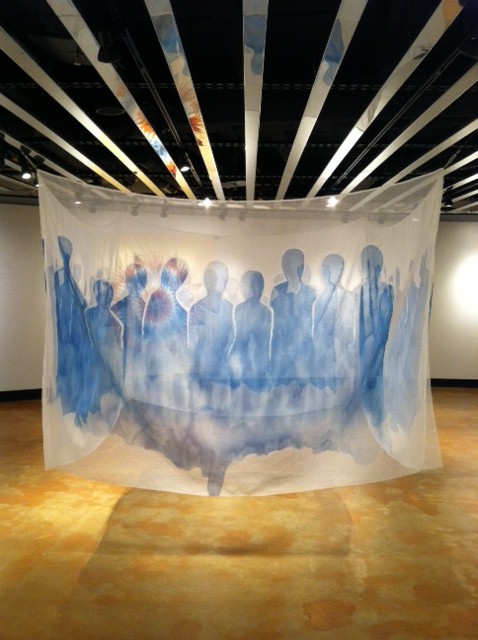
(Image: We are Here, textile art by Gwen Nell Westerman from her website)
Departing summer hath assumed An aspect tenderly illumed, The gentlest look of spring; That calls from yonder leafy shade Unfaded, yet prepared to fade, A timely carolling.
No faint and hesitating trill, Such tribute as to winter chill The lonely redbreast pays! Clear, loud, and lively is the din, From social warblers gathering in Their harvest of sweet lays.
Nor doth the example fail to cheer Me, conscious that my leaf is sere, And yellow on the bough:— Fall, rosy garlands, from my head! Ye myrtle wreaths, your fragrance shed Around a younger brow!
Yet will I temperately rejoice; Wide is the range, and free the choice Of undiscordant themes; Which, haply, kindred souls may prize Not less than vernal ecstasies, And passion's feverish dreams.
For deathless powers to verse belong, And they like Demi-gods are strong On whom the Muses smile; But some their function have disclaimed, Best pleased with what is aptliest framed To enervate and defile.
Not such the initiatory strains Committed to the silent plains In Britain's earliest dawn: Trembled the groves, the stars grew pale, While all-too-daringly the veil Of nature was withdrawn!
Nor such the spirit-stirring note When the live chords Alcæus smote, Inflamed by sense of wrong; Woe! woe to Tyrants! from the lyre Broke threateningly, in sparkles dire Of fierce vindictive song.
And not unhallowed was the page By wingèd Love inscribed, to assuage The pangs of vain pursuit; Love listening while the Lesbian Maid With finest touch of passion swayed Her own Æolian lute.
O ye, who patiently explore The wreck of Herculanean lore, What rapture! could ye seize Some Theban fragment, or unroll One precious, tender-hearted scroll Of pure Simonides.
That were, indeed, a genuine birth Of poesy; a bursting forth Of genius from the dust: What Horace gloried to behold, What Maro loved, shall we enfold? Can haughty Time be just!
-- William Wordsworth (1770-1850), English Romantic poet, poet laureate of England from 1843-1850.
When you are already here you appear to be only a name that tells of you whether you are present or not
and for now it seems as though you are still summer still the high familiar endless summer yet with a glint of bronze in the chill mornings and the late yellow petals of the mullein fluttering on the stalks that lean over their broken shadows across the cracked ground
but they all know that you have come the seed heads of the sage the whispering birds with nowhere to hide you to keep you for later
you who fly with them
you who are neither before nor after you who arrive with blue plums that have fallen through the night
perfect in the dew
-- W. S. Merwin (1927-2019), two time Poet Laureate of the United States (1999-200 and 2010-2011), two time Pulitzer Prize winner, translator, poet, anti-war activist, and ecologist
I believe my sin to be entirely common: the request for help Masking request for favor and the plea for pity thinly veiling complaint.
So little at peace in the spring evening, I pray for strength, for direction, but I also ask to survive my illness (the immediate one)—never mind anything in the future. I make this a special point, this unconcern for the future, also the courage I will have acquired by then to meet my suffering alone but with heightened fortitude.
Tonight, in my unhappiness, I wonder what qualities this presumes in the one who listens. And as the breeze stirs the leaves of the little birch tree, I construct a presence wholly skeptical and wholly tender, thus incapable of surprise.
I believe my sin is common, therefore intended; I can feel the leaves stir, sometimes with words, sometimes without, as though the highest form of pity could be irony.
Bedtime, they whisper. Time to begin lying.
--Louise Gluck (1943- ), American poet, and teacher, US Poet Laureate 2003, awarded the Nobel Prize for Literature for 2020
Ah, ah cries the crow arching toward the heavy sky over the marina. Lands on the crown of the palm tree.
Ah, ah slaps the urgent cove of ocean swimming through the slips. We carry canoes to the edge of the salt.
Ah, ah groans the crew with the weight, the winds cutting skin. We claim our seats. Pelicans perch in the draft for fish.
Ah, ah beats our lungs and we are racing into the waves. Though there are worlds below us and above us, we are straight ahead.
Ah, ah tattoos the engines of your plane against the sky—away from these waters. Each paddle stroke follows the curve from reach to loss.
Ah, ah calls the sun from a fishing boat with a pale, yellow sail. We fly by on our return, over the net of eternity thrown out for stars.
Ah, ah scrapes the hull of my soul. Ah, ah.
-- Joy Harjo (1951- ), poet laureate of the US, member of the Muscogee (Creek) Nation, teacher, musician, and native Tulsan, from How We Became Human: New and Selected Poems:1975-2001
Musical instruments sleep in the dark for several hours a day: the folks we belong to aren't always at play, so we can't always be at work.
Our silence holds music: an undiscovered bourne, horizons which have never been viewed, like undeclared love growing deeper in solitude, or the crystalline heart of a stone.
My sleep, however, was more like a death: in the dark of an attic for years; forgetting my existence, and my glorious career with the best female swing band on the earth.
I was the great love of my Sweetheart's life. A man came between us. And soon I was in the dark collecting dust and out of tune; they were pronounced man and wife.
Instead of the charts, my gal read Dr. Spock. We played once a week, once a year . . . At first, from my closet, I was able to hear her family's coninuo of talk.
My Sweetheart's grandson brought me to the shop. Something has ruined my voice. Older, not riper, I'm a sorry old bass. But that doesn't mean I've lost hope
. . .that someone will hold me in a tender embrace, her arms will encircle my neck; someone will press her warm length to my back, and pluck notes from my gut with her fingers' caress.
--Marilyn Nelson, from Sweethearts of Rhythm: The Story of the Greatest All-Girl Swing Band in the World