Showing posts with label Heaney S. Show all posts

Friday, October 4, 2024

Saint Francis and the Birds


When Francis preached love to the birds
They listened, fluttered, throttled up
Into the blue like a flock of words

Released for fun from his holy lips.
Then wheeled back, whirred about his head,
Pirouetted on brothers’ capes.

Danced on the wing, for sheer joy played
And sang, like images took flight.
Which was the best poem Francis made,

His argument true, his tone light.

--Seamus Heaney (1939-2013), Irish poet, Northern Irish poet, Nobel Prize winner, Oxford Professor of Poetry, and one of the pre-eminent poets of the 20th century.

Thursday, February 1, 2024

From Crossings


On St. Brigid's Day the new life could be entered
By going through her girdle of straw rope
The proper way for men was right leg first
Then right arm and right shoulder, head, then left
Shoulder, arm and leg.
Women drew it down
Over the body and stepped out of it
The open they came into by these moves
Stood opener, hoops came off the world
They could feel the February air
Still soft above their heads and imagine
The limp rope fray and flare like wind-born gleanings
Or an unhindered goldfinch over ploughland.

--Seamus Heaney (1935-2013), Irish poet, translator, teacher, essayist and winner of the Noble Prize for Literature

St. Brigid's Day is February 2.


Wednesday, October 4, 2023

Pangur Bán


Pangur Bán and I at work,
Adepts, equals, cat and clerk:
His whole instinct is to hunt,
Mine to free the meaning pent.

More than loud acclaim, I love
Books, silence, thought, my alcove.
Happy for me, Pangur Bán
Child-plays round some mouse’s den.

Truth to tell, just being here,
Housed alone, housed together,
Adds up to its own reward:
Concentration, stealthy art.

Next thing an unwary mouse
Bares his flank: Pangur pounces.
Next thing lines that held and held
Meaning back begin to yield.

All the while, his round bright eye
Fixes on the wall, while I
Focus my less piercing gaze
On the challenge of the page.

With his unsheathed, perfect nails
Pangur springs, exults and kills.
When the longed-for, difficult
Answers come, I too exult.

So it goes. To each his own.
No vying. No vexation.
Taking pleasure, taking pains,
Kindred spirits, veterans.

Day and night, soft purr, soft pad,
Pangur Bán has learned his trade.
Day and night, my own hard work
Solves the cruxes, makes a mark.

-- Anonymous 9th century monk, written in Irish, found in the monastery of St. Paul in Carinthia, southern Austria, translated by Seamus Heaney, with comments on the translation here.

Friday, June 2, 2023

St. Kevin and the Blackbird


And then there was St Kevin and the blackbird.
The saint is kneeling, arms stretched out, inside
His cell, but the cell is narrow, so

One turned-up palm is out the window, stiff
As a crossbeam, when a blackbird lands
And lays in it and settles down to nest.

Kevin feels the warm eggs, the small breast, the tucked
Neat head and claws and, finding himself linked
Into the network of eternal life,

Is moved to pity: now he must hold his hand
Like a branch out in the sun and rain for weeks
Until the young are hatched and fledged and flown.

*

And since the whole thing’s imagined anyhow,
Imagine being Kevin. Which is he?
Self-forgetful or in agony all the time

From the neck on out down through his hurting forearms?
Are his fingers sleeping? Does he still feel his knees?
Or has the shut-eyed blank of underearth

Crept up through him? Is there distance in his head?
Alone and mirrored clear in love’s deep river,
‘To labour and not to seek reward,’ he prays,

A prayer his body makes entirely
For he has forgotten self, forgotten bird
And on the riverbank forgotten the river’s name.

--Seamus Heaney (1939-2013), Irish poet, professor, winner of the 1995 Novel prize in Literature.

St. Kevin of Glendalough's feast day is June 3.

Seamus Heaney reads the poem and explicates it below:


Saturday, May 27, 2023

From "Glanmore Sonnets"


for Ann Saddlemyer
‘our heartiest welcomer’


Vowels ploughed into other: opened ground.
The mildest February for 20 years
Is mist bands over furrows, a deep no sound
Vulnerable to distant gargling tractors.
Our road is steaming, the turned-up acres breathe.
Now the good life could be to cross a field
And art a paradigm of earth knew from the lathe
Of plows. My lea is deeply tilled.
Old plough-socks gorge the subsoil of each sense
And I am quickened with a redolence
Of farmland as a dark unblown rose.
Wait then… Breasting the mist, in sowers’ aprons,
My ghosts come striding into their spring stations.
The dream grain whirls like freakish Easter snows.


--Seamus Heaney (1939-2013), from the “Glanmore Sonnets,” in Field Work, 1979

Wednesday, February 1, 2023

A Brigid's Girtle


Last time I wrote I wrote from a rustic table
Under magnolias in South Carolina
As blossoms fell on me, and a white gable
As clean-lined as the prow of a white liner

Bisected sunlight in the sunlit yard.
I was glad of the early heat and the first quiet
I'd had for weeks. I heard the mocking bird
And a delicious, articulate

Flight of small plinkings from a dulcimer
Like feminine rhymes migrating to the north
Where you faced the music and the ache of summer
And earth's foreknowledge gathered in the earth.

Now it's St Brigid's Day and the first snowdrop
In County Wicklow, and this a Brigid's Girdle
I'm plaiting for you, an airy fairy hoop
(Like one of those old crinolines they'd trindle),

Twisted straw that's lifted in a circle
To handsel and to heal, a rite of spring
As strange and lightsome and traditional
As the motions you go through going through the thing.

--Seamus Heaney (1939-2013 ) Irish poet, playwright, translator, and teacher, Nobel Prize Laureate in Literature, from The Spirit Level.

Today is the Feast of St. Brigid of Kildare.

Friday, June 17, 2022

A Found Poem


Like everybody else, I bowed my head
during the consecration of the bread and wine
lifted my eyes to the raised host and raised chalice,
believed (whatever it means) that a change occurred.
I went to the altar rails and received the mystery
on my tongue, returned to my place, shut my eyes fast, made
an act of thanksgiving, opened my eyes and felt
time starting up again.
There was never a scene
when I had it out with myself or with an other.
The loss of faith occurred off stage. Yet I cannot
disrespect words like ‘thanksgiving’ or ‘host’
or even ‘communion wafer.’ They have an undying
pallor and draw, like well water far down.

– Seamus Heaney (1939- 2013) Northern Irish poet, Nobel Prize winner, Oxford Professor of Poetry, and one of the pre-eminent poets of the 20th century 

Wednesday, June 15, 2022

The Peninsula


When you have nothing more to say, just drive 
For a day all round the peninsula. 
The sky is tall as over a runway, 
The land without marks, so you will not arrive 

But pass through, though always skirting landfall. 
At dusk, horizons drink down sea and hill, 
The ploughed field swallows the whitewashed gable 
And you’re in the dark again. Now recall 

The glazed foreshore and silhouetted log, 
That rock where breakers shredded into rags, 
The leggy birds stilted on their own legs, 
Islands riding themselves out into the fog, 

And drive back home, still with nothing to say 
Except that now you will uncode all landscapes 
By this: things founded clean on their own shapes, 
Water and ground in their extremity.

– Seamus Heaney (1939- 2013) Northern Irish poet, Nobel Prize winner, Oxford Professor of Poetry, and one of the pre-eminent poets of the 20th century 

Monday, January 10, 2022

Two Lorries


It's raining on black coal and warm wet ashes.
There are tyre-marks in the yard, Agnew's old lorry
Has all its cribs down and Agnew the coalman
With his Belfast accent's sweet-talking my mother.
Would she ever go to a film in Magherafelt?
But it's raining and he still has half the load

To deliver farther on. This time the lode
Our coal came from was silk-black, so the ashes
Will be the silkiest white. The Magherafelt
(Via Toomebridge) bus goes by. The half-stripped lorry
With its emptied, folded coal-bags moves my mother:
The tasty ways of a leather-aproned coalman!

And films no less! The conceit of a coalman ...
She goes back in and gets out the black lead
And emery paper, this nineteen-forties mother,
All business round her stove, half-wiping ashes
With a backhand from her cheek as the bolted lorry
Gets revved and turned and heads for Magherafelt

And the last delivery. Oh, Magherafelt!
Oh, dream of red plush and a city coalman
As time fastforwards and a different lorry
Groans into shot, up Broad Street, with a payload
That will blow the bus station to dust and ashes ...
After that happened, I'd a vision of my mother,

A revenant on the bench where I would meet her
In that cold-floored waiting room in Magherafelt,
Her shopping bags full up with shovelled ashes.
Death walked out past her like a dust-faced coalman
Refolding body-bags, plying his load
Empty upon empty, in a flurry

Of motes and engine-revs, but which lorry
Was it now? Young Agnew's or that other,
Heavier, deadlier one, set to explode
In a time beyond her time in Magherafelt ...
So tally bags and sweet-talk darkness, coalman,
Listen to the rain spit in new ashes

As you heft a load of dust that was Magherafelt,
Then reappear from your lorry as my mother's
Dreamboat coalman filmed in silk-white ashes.

--Seamus Heaney (1939-2013), Irish poet, playwright, translator, and Nobel Prize Winner

Tuesday, October 29, 2019

The Skylight


You were the one for skylights. I opposed 
Cutting into the seasoned tongue-and-groove 
Of pitch pine. I liked it low and closed, 
Its claustrophobic, nest-up-in-the-roof 
Effect. I liked the snuff-dry feeling, 
The perfect, trunk-lid fit of the old ceiling. 
Under there, it was all hutch and hatch. 
The blue slates kept the heat like midnight thatch. 
But when the slates came off, extravagant 
Sky entered and held surprise wide open. 
For days I felt like an inhabitant 
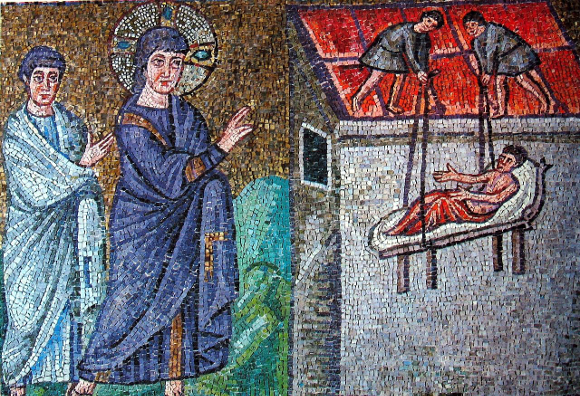
Of that house where the man sick of the palsy 
Was lowered through the roof, had his sins forgiven, 
Was healed, took up his bed and walked away.

—Seamus Heaney (1939 - 2013), Nobel prize-winning Irish poet and translator, from Seeing Things: Poems, 1991

Scripture reference: Luke 5:17-39

Friday, October 18, 2019

Had I Not Been Awake


Had I not been awake I would have missed it, 
A wind that rose and whirled until the roof 
Pattered with quick leaves off the sycamore 

And got me up, the whole of me a-patter, 
Alive and ticking like an electric fence: 
Had I not been awake I would have missed it, 

It came and went so unexpectedly 
And almost it seemed dangerously, 
Returning like an animal to the house, 

A courier blast that there and then 
Lapsed ordinary. But not ever 
After. And not now. 

 --Seamus Heaney (1939-2013), Irish poet, translator, and playwright, from Human Chain: Poems, 2011

Sunday, June 16, 2019

Digging


Between my finger and my thumb
The squat pen rests; snug as a gun.

Under my window, a clean rasping sound
When the spade sinks into gravelly ground:
My father, digging. I look down

Till his straining rump among the flowerbeds
Bends low, comes up twenty years away
Stooping in rhythm through potato drills
Where he was digging.

The coarse boot nestled on the lug, the shaft
Against the inside knee was levered firmly.
He rooted out tall tops, buried the bright edge deep
To scatter new potatoes that we picked,
Loving their cool hardness in our hands.

By God, the old man could handle a spade.
Just like his old man.

My grandfather cut more turf in a day
Than any other man on Toner’s bog.
Once I carried him milk in a bottle
Corked sloppily with paper. He straightened up
To drink it, then fell to right away
Nicking and slicing neatly, heaving sods
Over his shoulder, going down and down
For the good turf. Digging.

The cold smell of potato mould, the squelch and slap
Of soggy peat, the curt cuts of an edge
Through living roots awaken in my head.
But I’ve no spade to follow men like them.

Between my finger and my thumb
The squat pen rests.
I’ll dig with it.

—Seamus Heaney (1939-2013), Irish poet, Nobel laureate, teacher, and translator, from Death of a Naturalist, 1966.

Saturday, September 15, 2018

Lightenings viii


The annals say: when the monks of Clonmacnoise
Were all at prayers inside the oratory
A ship appeared above them in the air.
The anchor dragged along behind so deep
It hooked itself into the altar rails
And then, as the big hull rocked to a standstill,
A crewman shinned and grappled down a rope
And struggled to release it. But in vain.
`This man can’t bear our life here and will drown,’
The abbot said, `Unless we help him.’ So 
They did, the freed ship sailed and the man climbed back
Out of the marvelous as he had known it.

--Seamus Heaney (1939- ), Irish poet, recipient of the Nobel Prize in Literature, 1996


Image: Ruins of the Cathedral at Clonmacnoise, Ireland