Showing posts with label art. Show all posts

Thursday, August 17, 2023

The Cricket in the Sump


He falls abruptly silent when we fling
A basket down or bang the dryer shut,
But soon takes up again where he left off.
Swept by a rainstorm through a narrow trough
Clotted with cobwebs into Lord knows what
Impenetrable murk, he’s undeterred—
You’d think his dauntless solo was a chorus,
This rusty sump, a field or forest spring.
And there is something wondrous and absurd
About the way he does as he is bidden
By instinct, with his gift for staying hidden
While making sure unseen is plainly heard.

All afternoon his tremolo ascends
Clear to the second story, where a girl
Who also has learned blithely to ignore us
Sings to herself behind her bedroom door.
Maybe she moves to her invented score
With a conductor’s flourish, or pretends
She’s a Spanish dancer, lost in stamp and whirl
And waving fan—notes floating, as she plays,
Through the open window where the willow sways
And shimmers, humming to another string.
There is no story where the story ends.
What does a singer live for but to sing?


-- Catherine Tuffariello (1963- ), American poet and professor at Valparaiso University.

Thursday, August 3, 2023

Ruby Throated Moses


          When my eye caught the green surprise
of a hummingbird inside the dim garage,
          like a brooch pinned against the sheetrock wall, 
I canted open the creaking garage door 
          and tossed him back to blinding summer life. 
He spiraled into brilliance, out of sight. 

          When Michelangelo struck Moses’ knee 
and shouted at him, “Speak!,” the chisel made 
          a dent. But Moses kept his glaring silence. 
And yet, through the statue’s marble hair, a wildness 
          stuck out two ridged horns and spoke.
Let this be light, it said. Let this be light.


--Mark Jarman (1952- ), multiple award-winning New Formalist American poet, and emeritus Centennial Professor of English at Vanderbilt University, from The Heronry: Poems, 2017.

Thursday, March 3, 2022

The Third Temptation: Image from the Book of Kells


Here is the commentary from Trinity College's website on the image from the Book of Kells:

"The third Temptation of Jesus (f. 202v) is currently on display in the Old Library. The episode is described later in the narrative, at Luke’s Gospel 4.9–13 (f. 204r), where Satan urges Jesus to throw himself from the roof of the temple in Jerusalem in order to demonstrate that the angels will save him:

‘And [the devil] brought him to Jerusalem and set him on a pinnacle of the temple and said to him: If thou be the Son of God, cast thyself from hence. For it is written that He hath given his angels charge over thee that they keep thee. And that in their hands they shall bear thee up, lest perhaps thou dash thy foot against a stone. And Jesus answering, said to him: It is said: Thou shalt not tempt the Lord thy God.’

Jesus is represented on a shingle-roofed building which resembles an Irish shrine, with lions as finials. Protected by angels directly above him and in the top corners of the page, he holds out a slender glass vessel, possibly a chalice filled with Eucharistic wine, in response to the small, black winged figure of Satan on the right. Stylized peacocks, symbols of his Resurrection, are placed within the crosses on either side of Jesus.

The image presents many complexities and difficulties of interpretation. The haloed figure with crossed flabella at the centre of the temple may portray Christ as Judge in a Last Judgment scene. The temple and Jesus may represent, in an almost literal manner, the body of the church with Christ as its head, while the human figures – thirteen at the foot of the page and nine to Jesus’ right – seem to represent the faithful of the congregation. It is also possible to read the page as the ground plan of a church with four pillars, showing both side and front elevations. 

The figure of Satan has been disfigured by around twenty small stab marks to the neck, the arms and the torso. This controlled attack, not visible to the naked eye at first glance, seems to have been undertaken at a time when the book was bound, with the knife going through the vellum to previous leaves. The date of this intervention in the life of the Book of Kells is impossible to determine with accuracy, though it may be supposed to have occurred in the middle ages."

Thursday, March 25, 2021

The Annunciation

Starts with a stream of gold that’s ridden
      by a relentlessly linear dove,
ready to pierce a young girl’s head.

            Then, her face, her gaze looking up, out
past the easel and later, past the frame,
      eyes raised as if to ask a question. Take

the virgin robe, for instance, which van Eyck has made
      to fall luxuriously as a second chance
across the old storyline etched below her.

            And, further down, the church’s intricately
strict apse, each floorboard, painstaked as lace, showing here,
      David’s lesson in beheading, there Samson’s

tearing down the temple—that history
            interrupted by her silken, layered folds:
each blue built up from perfecting the oil.

            His favorite signature, “As best I can”
or “As I was able, but not just as I wished.”
      Imagine the endless effort: a man

in the distance, deep in the could have been,
      who sat before the easel, hours, perhaps,
past his patience for lasting regrets,

            flat refusals—the quick-drying water-based
attempts flung around a room.
      And how, alone with pigment barrels, chamber pots,

the canvasses stretched, the fire exhumed,
      he poured a stream of oil back and forth,
watching it catch the light, change a wooden bowl.

            For the sake of making the mundane
seem to marry the mysterious,
      her eyes raised—lacquered, slippery wells, caught—

her startled acceptance. Since it’s her choosing
      to be chosen that mattered, largest figure
in the frame, the virgin form layered

            with gold light, blue, her pale hands open
for the god imagined sick with thin horizon,
      and ready to enter thickness now, the body’s

blood, gristle, vertebrae, whorled fingerprint.
      The oil spread back and forth. His wrist stiffened.
“As I was able, but not just as I wished.”

            So, out to pay the right kind of attention
to detail, as if, in the lengthening
      carelessness of cracked roads leading away

from his town, beneath a matted pulp
      of the year’s leaves, he wished he could hear
silence taking shape: a weed, say, starting

            to split the surface, part vegetal
altar and example of dumb, green change.
      Or, say, through the window, a flock of geese

receding, advancing, by turns, as the sky’s gray
      sometimes meets the double strength gray of sea,
he might have looked between the shapes,

            their invisible lines blooded, some racing ahead,
others falling behind, each filling in, quickly,
      empty spaces where the wings once beat.

And still, she looks up, asking to be entered.
      So that if she turned away from shadows, wood panels,
chamber pots, winter coats lined against the wall,

            he might have looked so far into the difficult
that he finally could believe: behind her gaze,
      beneath her brow, under the layers of

shell, salt, finally skin-white, lay the mind
      of a mother giving birth to a father
and a son, the flesh—a color, an instant, spared.

-- Pimone Triplett, poet and professor, from Ruining the Picture.
Image: The Annunciation, by Jan Van Eyck 

Monday, March 23, 2020

The Raising of Lazarus: Art for Lent 5A

Hanna Varghese, Jesus Wept

Mosaic, Lazarus Comes Forth from the Tomb


Icon, unknown

Sadao Watanabe, The Raising of Lazarus

Giotto di Bondon, The Raising of Lazarus 1304 

unknown icon, the Raising of Lazarus

Vincent Van Gogh, The Raising of Lazarus (after Rembrandt), 1890

Vincent Van Gogh, Notes and sketch on Lazarus

Tuesday, March 17, 2020

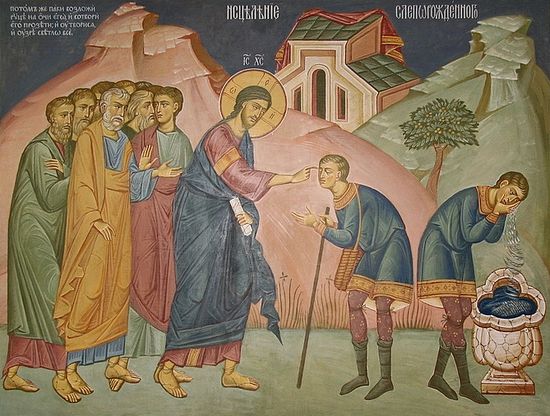
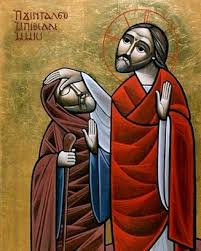
The Man No Longer Blind: Art for Lent 4A

by Ann Lukesh

Ethiopian icon

Greek icon

Modern icon

artist unknown

Russian icon

Modern icon, artist unknown

Mosaic

By Sadao Watanabe, modern Japanese printmaker

Relevant scripture: John 9:1-41

Monday, March 9, 2020

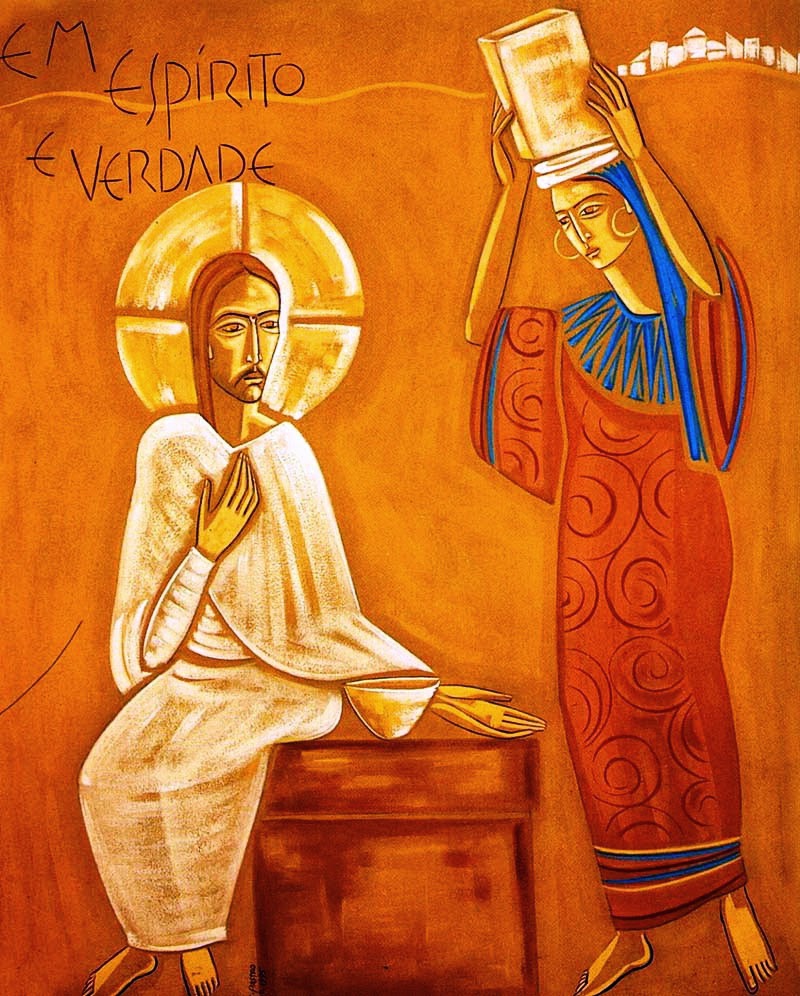
The Samaritan Woman at the Well: Art for Lent 3A

Scripture Reference: John 4:5-42, Gospel for Lent 3A

Modern Latin American

late 19th century Orthodox icon

Modern Icon

Joseph Kleitsch (1885-1931), Woman at the Well

Japanese Print
Odilon Redon, Christ and Samaritan Woman at Well


Tuesday, March 3, 2020

Jesus and Nicodemus: Art for Lent 2A

Harold Copping, Nicodemus


James Tissot, Jesus and Nicodemus, from the Brooklyn Museum of Art

Jesuit House Iñigo, Bruges, Belgium, carving of  Jesus and  Nicodemus, 1880

Richard Hook, Jesus and Modern-day Nicodemus

Jesus and Nicodemus, Jesus Mafa

Henry Ossawa Tanner, Nicodemus Visiting Jesus, 1899

Henry Ossawa Tanner, study for Nicodemus Visiting Jesus, 1899

Henry Ossawa Tanner, another study for Nicodemus Visitn Jesus, 1899

Tuesday, February 25, 2020

Jesus is Tempted in the Wilderness: Art for Lent 1A

12th Century New Roman Mosaic of the Cathedral of the Nativity of the Most Holy Mother of God in Monreale in Sicily

Felix Jospeh Barrias, The Temptation of Christ by the Devil, 1860

James Tissot, Jesus Tempted in the Wilderness (Jésus tenté dans le désert), 1886-1894, one of 350 watercolors in his episcopal series on the life of Christ from the Bible, from the Brooklyn Museum of Art

James Tissot, Jesus Carried Up to the Pinnacle of the Temple (Jésus porté sur le pinacle du Temple), 1886-1894, from the Brooklyn Museum
James Tissot (French, 1836-1902). Jesus Transported by a Spirit onto a High Mountain (Jésus transporté par l'esprit sur une haute montagne), 1886-1894, from the Brooklyn Museum of Art

James Tissot, Jesus Ministered to by Angels (Jésus assisté par les anges), 1886-1894, from the Brooklyn Museum of Art
Ducci di Buoninsegna, detail, The Temptation of Christ, 1310

Eric Armusik, The Temptation of Christ, 2011
James B. Janknegt, The Temptation of Christ, 1990


Relevant Scripture: Matthew 4:1-11


Monday, May 13, 2019

The Servant Girl at Emmaus


(A Painting by Velázquez)

She listens, listens, holding
her breath. Surely that voice
is his—the one
who had looked at her, once, across the crowd,
as no one ever had looked?
Had seen her? Had spoken as if to her?

Surely those hands were his,
taking the platter of bread from hers just now?
Hands he'd laid on the dying and made them well?

Surely that face—?

The man they'd crucified for sedition and blasphemy.
The man whose body disappeared from its tomb.
The man it was rumored now some women had
seen this morning, alive?

Those who had brought this stranger home to their table
don't recognize yet with whom they sit.
But she in the kitchen, absently touching
         the winejug she's to take in,
a young Black servant intently listening,

swings round and sees
the light around him
and is sure.

--Denise Levertov (1923–1997), Anglo-American poet

Tuesday, October 16, 2018

Power is Safest in the Poet's Hands


Power is safest in the poet's hands, thus for the poet
God will
pose.

The realms of thought, sublimely wild, the finest pigments of
ground suns, the violin's divine plea for a 
true friend;

what is all this world has seen from art: the shadow more true and
glorious there

than in the cage where there is often talk of right and wrong.

The reins of God say to his lover,

"Hold me in your mouth, dear,
as you toil with all your limbs and strength
to free the magnificence
in man."

The reins of the Sky sing,

"Grab hold, and you will know God
lowers His cup into you
to drink."

--Shams-ud-din Muhammad Hafiz (ca 1320-1389), Persian mystic poet, from Love Poems from God: Twelve Sacred Voices from the East and West, Daniel Ladinsky, ed.