Showing posts with label Lent A. Show all posts

Tuesday, March 28, 2023

The Donkey


When fishes flew and forests walked
And figs grew upon thorn,
Some moment when the moon was blood
Then surely I was born;

With monstrous head and sickening cry
And ears like errant wings,
The devil’s walking parody
On all four-footed things.

The tattered outlaw of the earth,
Of ancient crooked will;
Starve, scourge, deride me: I am dumb,
I keep my secret still.

Fools! For I also had my hour;
One far fierce hour and sweet:
There was a shout about my ears,
And palms before my feet.


-- G. K. Chesterton (1874-1936), English critic, novelist, poet, and convert to Roman Catholicism

Scripture Reference: Matthew 21:1-11, Palm Sunday, Lent A


Saturday, March 25, 2023

Watching and Waiting (Psalm 130)


          Dare I enter the dark?

                Refrain: costing not less than everything,
                all manner of things shall be well.

Empty, exhausted, and ravaged,
in the depths of despair I writhe.
Anguished and afflicted, terribly alone,
I trudge a bleak wasteland, devoid of all love.

In the echoing abyss I call out:
no God of Compassion hears my voice.
Yet still I pray, Open your heart,
for my tears well up within me.

If you keep account of all that drags me down,
there is no way I can ever stand firm.
Paralyzed and powerless, I topple over,
bound by the evil I hate.

But with you is forgiveness and grace,
there is nothing I can give - it seems like a death.
The power of your love is so awesome:
I am terrified by your freeing embrace.

Drawn from the murky deeps by a fishhook,
I shout to the air that will kill me:
must I leave behind all that I cherish
before I can truly breathe free?

Suspended between one world and the next,
I waited for you, my God.
Apprehension and hope struggled within me,
I waited, I longed for your word.

As a watchman waits for the morning,
through the darkest and coldest of nights,
more even than the watchman who peers through the gloom,
I hope for the dawn, I yearn for the light.

You will fulfill your promise to bring me alive,
overflowing with generous love.
You will free me from the grip of evil,
O God of mercy and compassion.

Touching and healing the whole of my being,
you are a God whose reach has no limit.
All that has been lost will one day be found:
the communion of the rescued will rejoice in your name.


-- Jim Cotter, Anglican priest and poet, from Psalms for a Pilgrim People

Scripture reference: Psalm 130, Lent 5A

Thursday, March 23, 2023

I Lazarus


What could I make of the grass
But a gate to the skies
Looking up
Clouds floating by
Like the shapes of the dead ones
As radiant as angels
And when I opened the earth
Their tombs were all empty
My mother and father
The first to speak
Come here son
O how we missed you
All I could do was weep


— Stephen Rybicki (1941-2022), poet and librarian, from Commonweal magazine.

Wednesday, March 22, 2023

Lazarus Unbound


John 11:1-45


To the sound of distant weeping I exited:
“Eleazar, Eleazar,” my sisters cried
but the keen came as if from the bottom of a well,
recessing like a long, slow tide; fevered rasp
of buzzing insects in the sick room;
and my scroll was torn in half with what I thought
was finality.

All was still. I rose and spun
and I cooled like a stone skipped into a river
pain and broken body shrugged off, a spent husk:

At this point of the page I resume:
I had shed this tomb of a body and rolled back the stone.
In golden sunlight, walking under a canopy
of lupine-blue sky, hands at waist facing forward, fingers open
as bobbing seas of wildflowers
- anemones and poppies, rockrose, Aaron’s rod-
weave their stems around my wrists,
and I absorb the honeyed petrichor of a desert in bloom,
murmuration of sparrows from a wadi nearby

swallows swooping from the tops of locust trees.
The difference between a field and a wasteland is in the flowers.
All was rest. All was God. All was peace.

A kaleidoscope of colors and I am jerked back
by the voice of love, insistent.
From the depths he called me to rising with a voice tear-choked.
Then the longed-for renewal of breath back into a body
now stretched like a new wineskin across my soul.
I am a somnambulist, stumbling pale in my shroud
toward an aperture so bright all was white beyond,
heart pounding like a child’s eager fist at a door.


--Leslie Barnes Scoopmire, March 22, 2023


This was first published at Episcopal Journal and Cafe's Speaking to the Soul on March 23, 2023.

Scripture Reference: John 11:1-45, Lent 5A
Image: Jose Luis Castrillo, The Resurrection of Lazarus

Onto a Vast Plain


You are not surprised at the force of the storm–
you have seen it growing.
The trees flee. Their flight
sets the boulevards streaming. And you know:
he whom they flee is the one
you move toward. All your senses
sing him, as you stand at the window.

The weeks stood still in summer.
The trees’ blood rose. Now you feel
it wants to sink back
into the source of everything. You thought
you could trust that power
when you plucked the fruit:
now it becomes a riddle again
and you again a stranger.

Summer was like your house: you know
where each thing stood.
Now you must go out into your heart
as onto a vast plain. Now
the immense loneliness begins.
The days go numb, the wind
sucks the world from your senses like withered leaves.

Through the empty branches the sky remains.
It is what you have.
Be earth now, and evensong.
Be the ground lying under that sky.
Be modest now, like a thing
ripened until it is real,
so that he who began it all
can feel you when he reaches for you.

– Rainer Maria Rilke (1875-1926), Austrian poet and novelist, from The Book of Hours, translated by Joanna Macy and Anita Barrows

Scripture Reference: John 11:1-45, Lent 5A

Image: "Jesus Raises Lazarus from the Dead," by Ann Lukesh

Lazarus Risen


Lumbering out into the hectic light
like some dishevelled beast, I found myself
notorious, and would have turned back
but that cool and candid gaze unstitched
my shroud till it fell in shreds about me
and I walked among my weeping, bewildered kin.

Now their houses fall silent when I enter,
whey-faced and hesitant. For miles around
kids run howling home at the sound of my name
and when I pass even the trees look askance.
Sustained by a miracle, like flowers in a vase
my astonishing life continues in parenthesis.

Daily, strangers beat on my door.
How should I expect them to understand
my need for darkened rooms and blankets?
I still remember
Barabbas, drunk, circling the cross as blood
issued like a parable no one understood.

When they buried him I hid and waited
and saw his ragged body bleach the stones
and vanish. My arms hung like questions in the air.
They say my wits disdained that brusque choir
and smile at the familiar idiocy
that drives me now to watch in the evenings

the unearthly procession of light
from the grey loaves of the cemetery.
I think of silences broken only
by flesh loosening, the dry applause of bones,
while with growing confidence the spiky stars
transmit their small, post-dated fires.

Peter Sirr, from Selected Poems(2005)

Scripture reference: John 11:1-45, Lent 5A

The Raising of Lazarus


Adapted from the original notebook fragment written by Rainer Maria Rilke in Spain in 1913.


Evidently, this was needed. Because people need
to be screamed at with proof.
But he knew his friends. Before they were
he knew them. And they knew
that he would never leave them
there, desolate. So he let his exhausted eyes close
at first glimpse of the village fringed with tall fig
trees — 
immediately he found himself in their midst:
here was Martha, sister of the dead
boy. He knew
she would not stray,
as he knew which would;
he knew that he would always find her
at his right hand,
and beside her
her sister Mary, the one
a whole world of whores
still stood in a vast circle pointing at. Yes,
all were gathered around him. And once again
he began to explain
to bewildered upturned faces
where it was he had to go, and why.
He called them “my friends.” The Logos, God’s
creating word, — the same voice that said
Let there be light.
Yet
when he opened his eyes,
he found himself standing apart.
Even the two
slowly backing away, as though
from concern for their good name.
Then he began to hear voices;
whispering
quite distinctly,
or thinking:
Lord,
if you had been here
our friend might not have died.
(At that, he slowly reached out
as though to touch a face,
and soundlessly started to cry.)
He asked them the way to the grave.
And he followed behind them,
preparing
to do what is not done
to that green silent place
where life and death are one.
By then other Brueghelian grotesques
had gathered, toothlessly sneering
across at each other and stalled
at some porpoise or pig stage
of ontogenetical horrorshow, keeping
their own furtive shadowy distances
and struggling to keep up
like packs of limping dogs;
merely to walk down this road
in broad daylight
had begun to feel illegal,
unreal, rehearsal,
test — but for what!
And the filth of desecration
sifting down over him, as a feverish outrage
rose up, contempt
at the glib ease
with which words like “living”
and “being dead”
rolled off their tongues;
and loathing flooded his body
when he hoarsely cried,
“Move the stone!”
“By now the body must stink,”
some helpfully suggested. But it was true
that the body had lain in its grave four days.
He heard the voice as if from far away,
beginning to fill with that gesture
which rose through him: no hand that heavy
had ever reached this height, shining
an instant in air. Then
all at once clenching
and cramped — the fingers
shrunk crookedly
into themselves,
and irreparably fixed there,
like a hand with scars of ghastly
slashing lacerations
and the usual deep sawing
across the wrist’s fret,
through all major nerves,
the frail hair-like nerves — 
so his hand
at the thought
all the dead might return
from that tomb
where the enormous cocoon
of the corpse was beginning to stir.
Yet nobody stood there — 
only the one young man,
pale as though bled,
stooping at the entrance
and squinting at the light,
picking at his face, loose
strips of rotting shroud.
All that he could think of
was a dark place to lie down,
and hide that wasted body.
And tears rolled up his cheek
and back into his eyes,
and then his eyes began
rolling back into his head ...    
Peter looked across at Jesus
with an expression that seemed to say
You did it, or What have you done?
And everyone saw
how their vague and inaccurate
life made room for his once more.

--Franz Wright (1953-2015), Austrian-born American poet, teacher, and translator, son of James Wright

Scripture Reference: John 11:1-45, Lent 5A

Tuesday, March 21, 2023

Lazarus


“No, Mary, there was nothing—not a word.
Nothing, and always nothing. Go again
Yourself, and he may listen—or at least
Look up at you, and let you see his eyes.
I might as well have been the sound of rain,
A wind among the cedars, or a bird;
Or nothing. Mary, make him look at you;
And even if he should say that we are nothing,
To know that you have heard him will be something.
And yet he loved us, and it was for love
The Master gave him back. Why did he wait
So long before he came? Why did he weep?
I thought he would be glad—and Lazarus—
To see us all again as he had left us—
All as it was, all as it was before.”

Mary, who felt her sister’s frightened arms
Like those of someone drowning who had seized her,
Fearing at last they were to fail and sink
Together in this fog-stricken sea of strangeness,
Fought sadly, with bereaved indignant eyes,
To find again the fading shores of home
That she had seen but now could see no longer
Now she could only gaze into the twilight,
And in the dimness know that he was there,
Like someone that was not. He who had been
Their brother, and was dead, now seemed alive
Only in death again—or worse than death;
For tombs at least, always until today,
Though sad were certain. There was nothing certain
For man or God in such a day as this;
For there they were alone, and there was he—
Alone; and somewhere out of Bethany,
The Master—who had come to them so late,
Only for love of them and then so slowly,
And was for their sake hunted now by men
Who feared Him as they feared no other prey—
For the world’s sake was hidden. “Better the tomb
For Lazarus than life, if this be life,”
She thought; and then to Martha, “No, my dear,”
She said aloud; “not as it was before.
Nothing is ever as it was before,
Where Time has been. Here there is more than Time;
And we that are so lonely and so far
From home, since he is with us here again,
Are farther now from him and from ourselves
Than we are from the stars. He will not speak
Until the spirit that is in him speaks;
And we must wait for all we are to know,
Or even to learn that we are not to know.
Martha, we are too near to this for knowledge,
And that is why it is that we must wait.
Our friends are coming if we call for them,
And there are covers we’ll put over him
To make him warmer. We are too young, perhaps,
To say that we know better what is best
Than he. We do not know how old he is.
If you remember what the Master said,
Try to believe that we need have no fear.
Let me, the selfish and the careless one,
Be housewife and a mother for tonight;
For I am not so fearful as you are,
And I was not so eager.”

Martha sank
Down at her sister’s feet and there sat watching
A flower that had a small familiar name
That was as old as memory, but was not
The name of what she saw now in its brief
And infinite mystery that so frightened her
That life became a terror. Tears again
Flooded her eyes and overflowed. “No, Mary,”
She murmured slowly, hating her own words
Before she heard them, “you are not so eager
To see our brother as we see him now;
Neither is he who gave him back to us.
I was to be the simple one, as always,
And this was all for me.” She stared again
Over among the trees where Lazarus,
Who seemed to be a man who was not there,
Might have been one more shadow among shadows,
If she had not remembered. Then she felt
The cool calm hands of Mary on her face,
And shivered, wondering if such hands were real.

“The Master loved you as he loved us all,
Martha; and you are saying only things
That children say when they have had no sleep.
Try somehow now to rest a little while;
You know that I am here, and that our friends
Are coming if I call.”

Martha at last
Arose, and went with Mary to the door,
Where they stood looking off at the same place,
And at the same shape that was always there
As if it would not ever move or speak,
And always would be there. “Mary, go now,
Before the dark that will be coming hides him.
I am afraid of him out there alone,
Unless I see him; and I have forgotten
What sleep is. Go now—make him look at you—
And I shall hear him if he stirs or whispers.
Go!—or I’ll scream and bring all Bethany
To come and make him speak. Make him say once
That he is glad, and God may say the rest.
Though He say I shall sleep, and sleep for ever,
I shall not care for that… Go!”

Mary, moving
Almost as if an angry child had pushed her,
Went forward a few steps; and having waited
As long as Martha’s eyes would look at hers,
Went forward a few more, and a few more;
And so, until she came to Lazarus,
Who crouched with his face hidden in his hands,
Like one that had no face. Before she spoke,
Feeling her sister’s eyes that were behind her
As if the door where Martha stood were now
As far from her as Egypt, Mary turned
Once more to see that she was there. Then, softly,
Fearing him not so much as wondering
What his first word might be, said, “Lazarus,
Forgive us if we seemed afraid of you;”
And having spoken, pitied her poor speech
That had so little seeming gladness in it,
So little comfort, and so little love.

There was no sign from him that he had heard,
Or that he knew that she was there, or cared
Whether she spoke to him again or died
There at his feet. “We love you, Lazarus,
And we are not afraid. The Master said
We need not be afraid. Will you not say
To me that you are glad? Look, Lazarus!
Look at my face, and see me. This is Mary.”
She found his hands and held them. They were cool,
Like hers, but they were not so calm as hers.
Through the white robes in which his friends had wrapped him
When he had groped out of that awful sleep,
She felt him trembling and she was afraid.
At last he sighed; and she prayed hungrily
To God that she might hear again the voice
Of Lazarus, whose hands were giving her now
The recognition of a living pressure
That was almost a language. When he spoke,
Only one word that she had waited for
Came from his lips, and that word was her name.

“I heard them saying, Mary, that he wept
Before I woke.” The words were low and shaken,
Yet Mary knew that he who uttered them
Was Lazarus; and that would be enough
Until there should be more… “Who made him come,
That he should weep for me?… Was it you, Mary?”
The questions held in his incredulous eyes
Were more than she would see. She looked away;
But she had felt them and should feel for ever,
She thought, their cold and lonely desperation
That had the bitterness of all cold things
That were not cruel. “I should have wept,” he said,
“If I had been the Master….”

Now she could feel
His hands above her hair—the same black hair
That once he made a jest of, praising it,
While Martha’s busy eyes had left their work
To flash with laughing envy. Nothing of that
Was to be theirs again; and such a thought
Was like the flying by of a quick bird
Seen through a shadowy doorway in the twilight.
For now she felt his hands upon her head,
Like weights of kindness: “I forgive you, Mary….
You did not know—Martha could not have known—
Only the Master knew…. Where is he now?
Yes, I remember. They came after him.
May the good God forgive him…. I forgive him.
I must; and I may know only from him
The burden of all this… Martha was here—
But I was not yet here. She was afraid….
Why did he do it, Mary? Was it—you?
Was it for you?… Where are the friends I saw?
Yes, I remember. They all went away.
I made them go away…. Where is he now?…
What do I see down there? Do I see Martha—
Down by the door?… I must have time for this.”

Lazarus looked about him fearfully,
And then again at Mary, who discovered
Awakening apprehension in his eyes,
And shivered at his feet. All she had feared
Was here; and only in the slow reproach
Of his forgiveness lived his gratitude.
Why had he asked if it was all for her
That he was here? And what had Martha meant?
Why had the Master waited? What was coming
To Lazarus, and to them, that had not come?
What had the Master seen before he came,
That he had come so late?

“Where is he, Mary?”
Lazarus asked again. “Where did he go?”
Once more he gazed about him, and once more
At Mary for an answer. “Have they found him?
Or did he go away because he wished
Never to look into my eyes again?…
That, I could understand…. Where is he, Mary?”

“I do not know,” she said. “Yet in my heart
I know that he is living, as you are living—
Living, and here. He is not far from us.
He will come back to us and find us all—
Lazarus, Martha, Mary—everything—
All as it was before. Martha said that.
And he said we were not to be afraid.”
Lazarus closed his eyes while on his face
A tortured adumbration of a smile
Flickered an instant. “All as it was before,”
He murmured wearily. “Martha said that;
And he said you were not to be afraid …
Not you… Not you… Why should you be afraid?
Give all your little fears, and Martha’s with them,
To me; and I will add them unto mine,
Like a few rain-drops to Gennesaret.”

“If you had frightened me in other ways,
Not willing it,” Mary said, “I should have known
You still for Lazarus. But who is this?
Tell me again that you are Lazarus;
And tell me if the Master gave to you
No sign of a new joy that shall be coming
To this house that he loved. Are you afraid?
Are you afraid, who have felt everything—
And seen…?”

But Lazarus only shook his head,
Staring with his bewildered shining eyes
Hard into Mary’s face. “I do not know,
Mary,” he said, after a long time.
“When I came back, I knew the Master’s eyes
Were looking into mine. I looked at his,
And there was more in them than I could see.
At first I could see nothing but his eyes;
Nothing else anywhere was to be seen—
Only his eyes. And they looked into mine—
Long into mine, Mary, as if he knew.”

Mary began to be afraid of words
As she had never been afraid before
Of loneliness or darkness, or of death,
But now she must have more of them or die:
“He cannot know that there is worse than death,”
She said. “And you…”

“Yes, there is worse than death.”
Said Lazarus; “and that was what he knew;
And that is what it was that I could see
This morning in his eyes. I was afraid,
But not as you are. There is worse than death,
Mary; and there is nothing that is good
For you in dying while you are still here.
Mary, never go back to that again.
You would not hear me if I told you more,
For I should say it only in a language
That you are not to learn by going back.
To be a child again is to go forward—
And that is much to know. Many grow old,
And fade, and go away, not knowing how much
That is to know. Mary, the night is coming,
And there will soon be darkness all around you.
Let us go down where Martha waits for us,
And let there be light shining in this house.”

He rose, but Mary would not let him go:
“Martha, when she came back from here, said only
That she heard nothing. And have you no more
For Mary now than you had then for Martha?
Is Nothing, Lazarus, all you have for me?
Was Nothing all you found where you have been?
If that be so, what is there worse than that—
Or better—if that be so? And why should you,
With even our love, go the same dark road over?”

“I could not answer that, if that were so,”
Said Lazarus,—“not even if I were God.
Why should He care whether I came or stayed,
If that were so? Why should the Master weep—
For me, or for the world,—or save himself
Longer for nothing? And if that were so,
Why should a few years’ more mortality
Make him a fugitive where flight were needless,
Had he but held his peace and given his nod
To an old Law that would be new as any?
I cannot say the answer to all that;
Though I may say that he is not afraid,
And that it is not for the joy there is
In serving an eternal Ignorance
Of our futility that he is here.
Is that what you and Martha mean by Nothing?
Is that what you are fearing? If that be so,
There are more weeds than lentils in your garden.
And one whose weeds are laughing at his harvest
May as well have no garden; for not there
Shall he be gleaning the few bits and orts
Of life that are to save him. For my part,
I am again with you, here among shadows
That will not always be so dark as this;
Though now I see there’s yet an evil in me
That made me let you be afraid of me.
No, I was not afraid—not even of life.
I thought I was…I must have time for this;
And all the time there is will not be long.
I cannot tell you what the Master saw
This morning in my eyes. I do not know.
I cannot yet say how far I have gone,
Or why it is that I am here again,
Or where the old road leads. I do not know.
I know that when I did come back, I saw
His eyes again among the trees and faces—
Only his eyes; and they looked into mine—
Long into mine—long, long, as if he knew.”


--Edwin Arlington Robinson (1869-1935), American poet and playwright, three time winner of the Pulitzer Prize for Poetry, four-time nominee for the Nobel Prize in Literature.

Scripture Reference: John 11:1-45, Lent 5A

Image: John O'Reilly, The Raising of Lazarus

Monday, March 20, 2023

sorrows


who would believe them winged
who would believe they could be

beautiful            who would believe
they could fall so in love with mortals

that they would attach themselves
as scars attach and ride the skin


sometimes we hear them in our dreams
rattling their skulls           clicking their bony fingers

envying our crackling hair
our spice filled flesh


they have heard me beseeching
as I whispered into my own

cupped hands          enough not me again
enough        but who can distinguish

one human voice
amid such choruses of desire


--Lucille Clifton (1936-2010), African American poet, author, and teacher, three time Pulitzer Prize nominee and winner of the National Book Award for Blessing the Boats: New and Selected Poems 1988-2000.

Scripture reference: Psalm 130, Lent 5A

Thursday, March 2, 2023

Nicodemus Considers the Wind Doing As It Pleases


 John 3


Well, it’s always synergetic, lacing fingers with rain,
slicing clots from olive trees like a scalpel,
knotted leaves scraped away. Sometimes it just eases

down with the sun. Gauzy breath, piling torn branches
like ashes. With it’s oxygenating breath, it could rekindle
what smoulders. But facing abnegation, when backs turn,

it nips the drooping lobes of half-covered ears. It rushes
like blood toward the heart, climbing trees, only truly seen
when rippling over wide flung limbs that have been lifted up.

-- Matt Lee Miller, from Earth & Altar magazine, Feb 11, 2021

Scripture reference John 3:1-17, 2 Lent A

Wednesday, March 1, 2023

Where the Wind Blows


Abraham, back when
he was just two syllable Abram
heard the voice of God
from within his soul
speak so convincingly that even
as his molars still
rattled from the conversation,
he packed up
wife and cattle and nephew
and headed to an unknown land.
In doing so
he left behind
all he had ever known.

I am a good man,
admired, respected,
a leader.
So through the anonymity
of dark-veiled streets
I went, seeking answers,
overflowing with questions.

I started with oil:
Rabbi, we know
that you were sent by God.
He blinked up.

And to be fair,
I did barge in
in the middle of the night.

There were signs.
But I wanted answers.
Instead I got riddles.
And he left me here.

To be brave enough
to let go of our “certainties”
—which are often just opinions
wrapped up in fear
and cynicism.
“The wind blows
where it chooses.”
And I hear leaves
rattling down the narrow alleys

I took my questions to Jesus.
The answer took me
someplace unexpected.


-- Leslie Barnes Scoopmire. This was first published at Episcopal Journal and Cafe's Speaking to the Soul on March 2, 2023.

Scripture Reference: John 3:1-17, Lent 2A

Thursday, February 23, 2023

Marked By Love


Ashes to tie us to dust, 
the alleged poverty of too brief time on Earth,
but instead proclaims our kinship
with the flaring symphony of stars overhead,

The fragrant oil graves the ash upon each forehead,
and answers the ash’s challenge
with a proclamation of being chosen and beloved,
entrusted as heirs of God’s promised lovingkindness.

Then the cross,
the shape of love that never gives up,
drawn into the tender and wide open embrace
of the One, who proclaims with generous grace
that Love
always
wins.

Emptiness isn’t poverty,
but the ability to make room for something better,
hallowing and honoring us
by reminding us of our unity
with all of creation borne tenderly by God.


--Leslie Barnes Scoopmire. This was first published at Episcopal Journal and Cafe's Speaking to the Soul on February 23, 2023.

Tuesday, March 31, 2020

Barabbas


Son of man
Son of the Father--
who can
tell one from the other?
Son of man
must taste of death.
Father's son
I would rather
be the one
to return
to Father's side
than to remain
to mourn
man's son's pain.
So he died
while my breath
burned in the rain.

Son of man
dead for me,
crucified,
to set me free.
Son of the Father,
I must be
because my brother
toppled death
upon a tree.

The cross's death
becomes life's door.
Son of man
offers more
abundant life
than those whose scorn
had thought to kill
the coming morn.

Son of man
my life will turn
as to our Father
I return.

(Note: "Barabbas" literally means "son of the father" in Hebrew.)

--Madeleine L'Engle (1918-2007), American novelist and poet, from A Cry Like a Bell

Scripture reference: Matthew 27:15-26 (Liturgy of the Word, Palm Sunday A)

Sunday, March 29, 2020

Lazarus


Now that he's gone
Now the world has moved on 
Since he called my name nothing's the same
As my sister cried He said, "Lazarus rise."
To love and anoint
Or just prove a point

I'm the one that he saved
I'm the one that he raised
From a dark quiet sleep from peace of the grave
I'm the one who owns much but that no one will touch
Mothers see me and cry
Dogs bare teeth as I walk by

I don't see a veil between heaven and hell
The truth is there's nothing but a warm light and singing
But here in-between a voice haunts my dreams
Martha does what she can but won't look at my hands

I'm the one that he saved
I'm the one that he raised
From a dark quiet sleep from peace of the grave
I'm the one who owns much but that no one will touch
Mothers see me and cry
Dogs bare teeth as I walk by

I love the cool mornings
I love a hot meal
The pulse of the street night jasmine and clean sheets 
I can't sleep of rest I feel lost and hard pressed 
I wander these rooms still looking for you 
Now I ought to be grateful to drink from the grail
But I don't be belong on either side of this veil
I look down at my hands that are clasped in my lap
When he left this world I thought he'd take me back...

-- Carrie Newcomer, American singer-songwriter, from the album The Geography of Light

Scripture reference: John 11:1-45, 5th Sunday in Lent 


Tuesday, March 24, 2020

Raising Lazarus


Adapted from the original notebook fragment written by Rainer Maria Rilke in Spain in 1913.

Evidently, this was needed. Because people need 
to be screamed at with proof. 
But he knew his friends. Before they were 
he knew them. And they knew
that he would never leave them 
there, desolate. So he let his exhausted eyes close 
at first glimpse of the village fringed with tall fig 
trees —  
immediately he found himself in their midst: 
here was Martha, sister of the dead 
boy. He knew 
she would not stray, 
as he knew which would; 
he knew that he would always find her 
at his right hand, 
and beside her 
her sister Mary, the one 
a whole world of whores 
still stood in a vast circle pointing at. Yes, 
all were gathered around him. And once again 
he began to explain 
to bewildered upturned faces 
where it was he had to go, and why. 
He called them “my friends.” The Logos, God’s 
creating word, — the same voice that said 
Let there be light. 
Yet 
when he opened his eyes, 
he found himself standing apart. 
Even the two 
slowly backing away, as though 
from concern for their good name. 
Then he began to hear voices; 
whispering 
quite distinctly, 
or thinking: 
Lord, 
if you had been here 
our friend might not have died. 
(At that, he slowly reached out 
as though to touch a face, 
and soundlessly started to cry.) 
He asked them the way to the grave.
And he followed behind them, 
preparing 
to do what is not done 
to that green silent place 
where life and death are one. 
By then other Brueghelian grotesques 
had gathered, toothlessly sneering 
across at each other and stalled 
at some porpoise or pig stage 
of ontogenetical horrorshow, keeping 
their own furtive shadowy distances 
and struggling to keep up 
like packs of limping dogs; 
merely to walk down this road 
in broad daylight 
had begun to feel illegal, 
unreal, rehearsal, 
test — but for what! 
And the filth of desecration
sifting down over him, as a feverish outrage 
rose up, contempt 
at the glib ease 
with which words like “living” 
and “being dead” 
rolled off their tongues; 
and loathing flooded his body 
when he hoarsely cried, 
“Move the stone!” 
“By now the body must stink,” 
some helpfully suggested. But it was true 
that the body had lain in its grave four days. 
He heard the voice as if from far away, 
beginning to fill with that gesture 
which rose through him: no hand that heavy
had ever reached this height, shining 
an instant in air. Then 
all at once clenching 
and cramped — the fingers 
shrunk crookedly 
into themselves, 
and irreparably fixed there, 
like a hand with scars of ghastly 
slashing lacerations 
and the usual deep sawing 
across the wrist’s fret, 
through all major nerves, 
the frail hair-like nerves —  
so his hand 
at the thought 
all the dead might return 
from that tomb 
where the enormous cocoon 
of the corpse was beginning to stir. 
Yet nobody stood there —  
only the one young man, 
pale as though bled, 
stooping at the entrance 
and squinting at the light, 
picking at his face, loose 
strips of rotting shroud. 
All that he could think of 
was a dark place to lie down, 
and hide that wasted body. 
And tears rolled up his cheek 
and back into his eyes, 
and then his eyes began 
rolling back into his head ...     
Peter looked across at Jesus 
with an expression that seemed to say 
You did it, or What have you done? 
And everyone saw how their vague and inaccurate 
life made room for his once more.

-- Franz Wright (1953-2015), American poet and translator, son of poet James Wright

Relevant scripture: John 11:1-45

Monday, March 23, 2020

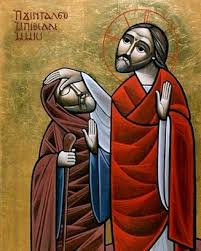
The Raising of Lazarus: Art for Lent 5A
Hanna Varghese, Jesus Wept

Mosaic, Lazarus Comes Forth from the Tomb


Icon, unknown

Sadao Watanabe, The Raising of Lazarus

Giotto di Bondon, The Raising of Lazarus 1304 

unknown icon, the Raising of Lazarus

Vincent Van Gogh, The Raising of Lazarus (after Rembrandt), 1890

Vincent Van Gogh, Notes and sketch on Lazarus

Tuesday, March 17, 2020

A Blind Woman


She had turned her face up into
a rain of light, and came on smiling.

The light trickled down her forehead
and into her eyes. It ran down 

into the neck of her sweatshirt
and wet the white tops of her breasts.

Her brown shoes splashed on
into the light. The moment was like

a circus wagon rolling before her
through puddles of light, a cage on wheels,

and she walked fast behind it,
exuberant, curious, pushing her cane

through the bars, poking and prodding,
while the world cowered back in a corner.

--Ted Kooser (1939- ), from Weather Central, 1994.

Relevant scripture: John 9:1-41

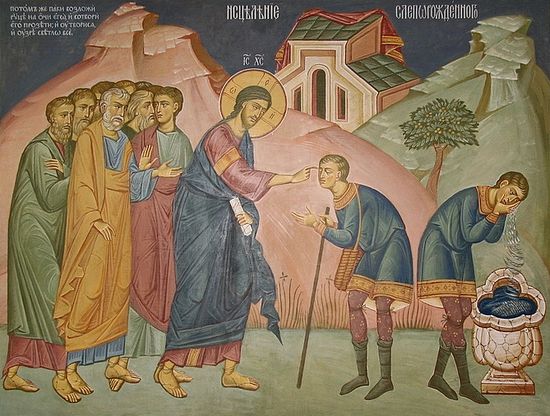
The Man No Longer Blind: Art for Lent 4A

by Ann Lukesh

Ethiopian icon

Greek icon

Modern icon

artist unknown

Russian icon

Modern icon, artist unknown

Mosaic

By Sadao Watanabe, modern Japanese printmaker

Relevant scripture: John 9:1-41