Showing posts with label Wordsworth W. Show all posts

Tuesday, September 20, 2022

A Narrow Girdle of Rough Stains and Crags


 A narrow girdle of rough stones and crags, 
 A rude and natural causeway, interposed 
 Between the water and a winding slope 
 Of copse and thicket, leaves the eastern shore 
 Of Grasmere safe in its own privacy: 
 And there myself and two beloved Friends, 
 One calm September morning, ere the mist 
 Had altogether yielded to the sun, 
 Sauntered on this retired and difficult way. ----
 Ill suits the road with one in haste; but we 
 Played with our time; and, as we strolled along, 
 It was our occupation to observe 
 Such objects as the waves had tossed ashore-- 
 Feather, or leaf, or weed, or withered bough, 
 Each on the other heaped, along the line 
 Of the dry wreck. And, in our vacant mood, 
 Not seldom did we stop to watch some tuft 
 Of dandelion seed or thistle's beard, 
 That skimmed the surface of the dead calm lake, 
 Suddenly halting now--a lifeless stand! 
 And starting off again with freak as sudden; 
 In all its sportive wanderings, all the while, 
 Making report of an invisible breeze 
 That was its wings, its chariot, and its horse, 
 Its playmate, rather say, its moving soul. --
And often, trifling with a privilege 
Alike indulged to all, we paused, one now, 
And now the other, to point out, perchance 
 To pluck, some flower or water-weed, too fair 
 Either to be divided from the place 
 On which it grew, or to be left alone 
 To its own beauty. Many such there are, 
 Fair ferns and flowers, and chiefly that tall fern, 
 So stately, of the queen Osmunda named; 
 Plant lovelier, in its own retired abode 
 On Grasmere's beach, than Naiad by the side 
 Of Grecian brook, or Lady of the Mere, 
 Sole-sitting by the shores of old romance. --
 So fared we that bright morning: from the fields 
 Meanwhile, a noise was heard, the busy mirth 
 Of reapers, men and women, boys and girls. 
 Delighted much to listen to those sounds, 
 And feeding thus our fancies, we advanced 
 Along the indented shore; when suddenly, 
 Through a thin veil of glittering haze was seen 
 Before us, on a point of jutting land, 
 The tall and upright figure of a Man 
 Attired in peasant's garb, who stood alone, 
 Angling beside the margin of the lake. 
 "Improvident and reckless," we exclaimed, 
 "The Man must be, who thus can lose a day 
 Of the mid harvest, when the labourer's hire 
 Is ample, and some little might be stored 
 Wherewith to cheer him in the winter time." 
 Thus talking of that Peasant, we approached 
 Close to the spot where with his rod and line 
 He stood alone; whereat he turned his head 
 To greet us--and we saw a Man worn down 
 By sickness, gaunt and lean, with sunken cheeks 
 And wasted limbs, his legs so long and lean 
 That for my single self I looked at them, 
 Forgetful of the body they sustained.-- 
 Too weak to labour in the harvest field, 
 The Man was using his best skill to gain 
 A pittance from the dead unfeeling lake 
 That knew not of his wants. I will not say 
 What thoughts immediately were ours, nor how 
 The happy idleness of that sweet morn, 
 With all its lovely images, was changed 
 To serious musing and to self-reproach. 
 Nor did we fail to see within ourselves 
 What need there is to be reserved in speech, 
 And temper all our thoughts with charity. --
Therefore, unwilling to forget that day, My Friend, 
Myself, and She who then received 
 The same admonishment, have called the place 
 By a memorial name, uncouth indeed 
 As e'er by mariner was given to bay 
 Or foreland, on a new-discovered coast; 
 And POINT RASH-JUDGMENT is the name it bears.

--William Wordsworth (1770-1850), English poet and British poet laureate

Monday, September 3, 2018

Composed upon Westminster Bridge, September 3, 1802


Earth has not anything to show more fair:
Dull would he be of soul who could pass by
A sight so touching in its majesty:
This City now doth, like a garment, wear
The beauty of the morning; silent, bare,
Ships, towers, domes, theatres, and temples lie
Open unto the fields, and to the sky;
All bright and glittering in the smokeless air
 Never did sun more beautifully steep
In his first splendour, valley, rock, or hill;
Ne'er saw I, never felt, a calm so deep!
The river glideth at his own sweet will:
Dear God! the very houses seem asleep;
And all that mighty heart is lying still!

--William Wordsworth (1770-1850), English poet and poet laureate

Saturday, April 7, 2018

Lines Written in Early Spring


I heard a thousand blended notes,
While in a grove I sate reclined,
In that sweet mood when pleasant thoughts
Bring sad thoughts to the mind.

To her fair works did Nature link
The human soul that through me ran;
And much it grieved my heart to think
What man has made of man.

Through primrose tufts, in that green bower,
The periwinkle trailed its wreaths;
And ’tis my faith that every flower
Enjoys the air it breathes.

The birds around me hopped and played,
Their thoughts I cannot measure: —
But the least motion which they made,
It seemed a thrill of pleasure.

The budding twigs spread out their fan,
To catch the breezy air;
And I must think, do all I can,
That there was pleasure there.

If this belief from heaven be sent,
If such be Nature’s holy plan,
Have I not reason to lament
What man has made of man?

--William Wordsworth (1770-1850) English poet

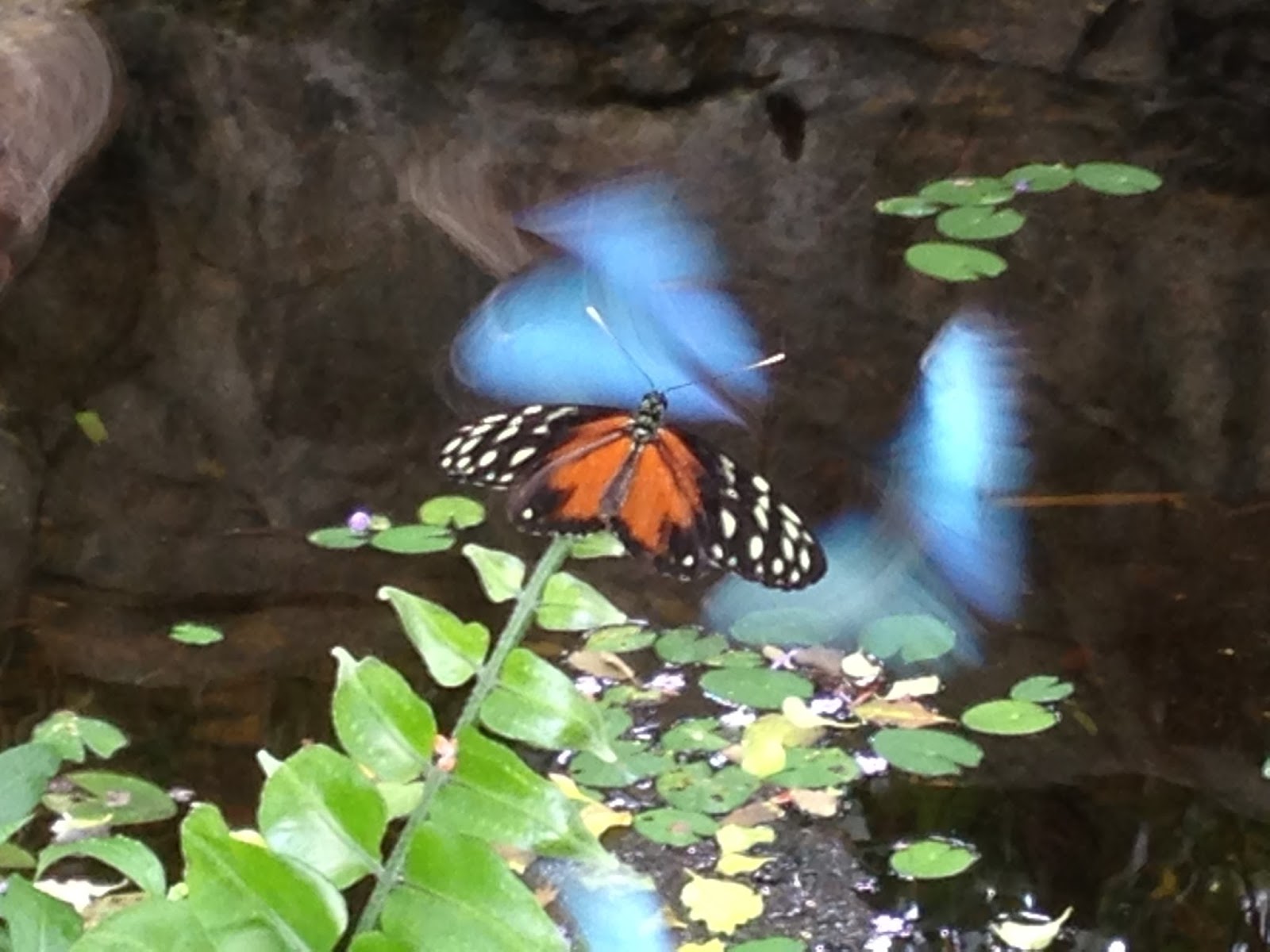
Photo: Morphos in Movement, St. Louis Butterfly house.

Friday, March 2, 2018

Ode: Intimations of Immortality


There was a time when meadow, grove, and stream,
     The earth, and every common sight,
               To me did seem
     Apparell'd in celestial light,
The glory and the freshness of a dream.
It is not now as it hath been of yore;—
          Turn wheresoe'er I may,
               By night or day,
The things which I have seen I now can see no more.


          The rainbow comes and goes,
          And lovely is the rose;
          The moon doth with delight
     Look round her when the heavens are bare;
          Waters on a starry night
          Are beautiful and fair;
     The sunshine is a glorious birth;
     But yet I know, where'er I go,
That there hath pass'd away a glory from the earth.

Now, while the birds thus sing a joyous song,
     And while the young lambs bound
          As to the tabor's sound,
To me alone there came a thought of grief:
A timely utterance gave that thought relief,
          And I again am strong:
The cataracts blow their trumpets from the steep;
No more shall grief of mine the season wrong;
I hear the echoes through the mountains throng,
The winds come to me from the fields of sleep,
          And all the earth is gay;
               Land and sea
     Give themselves up to jollity,
       And with the heart of May
     Doth every beast keep holiday;—
          Thou Child of Joy,
Shout round me, let me hear thy shouts, thou happy
     Shepherd-boy!

Ye blessèd creatures, I have heard the call
     Ye to each other make; I see
The heavens laugh with you in your jubilee;
     My heart is at your festival,
       My head hath its coronal,
The fulness of your bliss, I feel—I feel it all.
          O evil day! if I were sullen
          While Earth herself is adorning,
               This sweet May-morning,
          And the children are culling
               On every side,
          In a thousand valleys far and wide,
          Fresh flowers; while the sun shines warm,
And the babe leaps up on his mother's arm:—
          I hear, I hear, with joy I hear! —
          But there's a tree, of many, one,
A single field which I have look'd upon,
Both of them speak of something that is gone:
          The pansy at my feet
          Doth the same tale repeat:
Whither is fled the visionary gleam?
Where is it now, the glory and the dream?

Our birth is but a sleep and a forgetting:
The Soul that rises with us, our life's Star,
          Hath had elsewhere its setting,
             And cometh from afar:
          Not in entire forgetfulness,
          And not in utter nakedness,
But trailing clouds of glory do we come
          From God, who is our home:
Heaven lies about us in our infancy!
Shades of the prison-house begin to close
          Upon the growing Boy,
But he beholds the light, and whence it flows,
          He sees it in his joy;
The Youth, who daily farther from the east
     Must travel, still is Nature's priest,
     And by the vision splendid
     Is on his way attended;
At length the Man perceives it die away,
And fade into the light of common day.


Earth fills her lap with pleasures of her own;
Yearnings she hath in her own natural kind,
And, even with something of a mother's mind,
          And no unworthy aim,
     The homely nurse doth all she can
To make her foster-child, her Inmate Man,
     Forget the glories he hath known,
And that imperial palace whence he came.

Behold the Child among his new-born blisses,
A six years' darling of a pigmy size!
See, where 'mid work of his own hand he lies,
Fretted by sallies of his mother's kisses,
With light upon him from his father's eyes!
See, at his feet, some little plan or chart,
Some fragment from his dream of human life,
Shaped by himself with newly-learnèd art;
     A wedding or a festival,
     A mourning or a funeral;
          And this hath now his heart,
     And unto this he frames his song:
          Then will he fit his tongue
To dialogues of business, love, or strife;
          But it will not be long
          Ere this be thrown aside,
          And with new joy and pride
The little actor cons another part;
Filling from time to time his 'humorous stage'
With all the Persons, down to palsied Age,
That Life brings with her in her equipage;
          As if his whole vocation
          Were endless imitation.

Thou, whose exterior semblance doth belie
          Thy soul's immensity;
Thou best philosopher, who yet dost keep
Thy heritage, thou eye among the blind,
That, deaf and silent, read'st the eternal deep,
Haunted for ever by the eternal mind,—
          Mighty prophet! Seer blest!
          On whom those truths do rest,
Which we are toiling all our lives to find,
In darkness lost, the darkness of the grave;
Thou, over whom thy Immortality
Broods like the Day, a master o'er a slave,
A presence which is not to be put by;
          To whom the grave
Is but a lonely bed without the sense or sight
        Of day or the warm light,
A place of thought where we in waiting lie;
Thou little Child, yet glorious in the might
Of heaven-born freedom on thy being's height,
Why with such earnest pains dost thou provoke
The years to bring the inevitable yoke,
Thus blindly with thy blessedness at strife?
Full soon thy soul shall have her earthly freight,
And custom lie upon thee with a weight,
Heavy as frost, and deep almost as life!

          O joy! that in our embers
          Is something that doth live,
          That nature yet remembers
          What was so fugitive!
The thought of our past years in me doth breed
Perpetual benediction: not indeed
For that which is most worthy to be blest— 
Delight and liberty, the simple creed
Of childhood, whether busy or at rest,
With new-fledged hope still fluttering in his breast:—
          Not for these I raise
          The song of thanks and praise;
     But for those obstinate questionings
     Of sense and outward things,
     Fallings from us, vanishings;
     Blank misgivings of a Creature
Moving about in worlds not realized,
High instincts before which our mortal Nature
Did tremble like a guilty thing surprised:
          But for those first affections,
          Those shadowy recollections,
     Which, be they what they may,
Are yet the fountain-light of all our day,
Are yet a master-light of all our seeing;
  Uphold us, cherish, and have power to make
Our noisy years seem moments in the being
Of the eternal Silence: truths that wake,
               To perish never:
Which neither listlessness, nor mad endeavour,
               Nor Man nor Boy,
Nor all that is at enmity with joy,
Can utterly abolish or destroy!
     Hence in a season of calm weather
          Though inland far we be,
Our souls have sight of that immortal sea
          Which brought us hither,
     Can in a moment travel thither, 
And see the children sport upon the shore,
And hear the mighty waters rolling evermore.

Then sing, ye birds, sing, sing a joyous song!
          And let the young lambs bound
          As to the tabor's sound!
We in thought will join your throng,
          Ye that pipe and ye that play,
          Ye that through your hearts to-day
          Feel the gladness of the May!
What though the radiance which was once so bright
Be now for ever taken from my sight,
     Though nothing can bring back the hour
Of splendour in the grass, of glory in the flower;
          We will grieve not, rather find
          Strength in what remains behind;
          In the primal sympathy
          Which having been must ever be;
          In the soothing thoughts that spring'
          Out of human suffering;
          In the faith that looks through death,
In years that bring the philosophic mind.


And O ye Fountains, Meadows, Hills, and Groves,
Forebode not any severing of our loves!
Yet in my heart of hearts I feel your might;
I only have relinquish'd one delight
To live beneath your more habitual sway.
I love the brooks which down their channels fret,
Even more than when I tripp'd lightly as they;
The innocent brightness of a new-born Day
               Is lovely yet;
The clouds that gather round the setting sun
Do take a sober colouring from an eye
That hath kept watch o'er man's mortality;
Another race hath been, and other palms are won.
Thanks to the human heart by which we live,
Thanks to its tenderness, its joys, and fears,
To me the meanest flower that blows can give
Thoughts that do often lie too deep for tears.


--William Wordsworth (1770-1850)

Thursday, March 1, 2018

The World

The world is too much with us; late and soon,
Getting and spending, we lay waste our powers:
Little we see in Nature that is ours;
We have given our hearts away, a sordid boon!
This sea that bares her bosom to the moon;
The winds that will be howling at all hours,
And are up-gather'd now like sleeping flowers;
For this, for everything, we are out of tune;
It moves us not.—Great God! I'd rather be
A Pagan suckled in a creed outworn;
So might I, standing on this pleasant lea,
Have glimpses that would make me less forlorn;
Have sight of Proteus rising from the sea;
Or hear old Triton blow his wreathèd horn.

--William Wordsworth (1770-1850)


Wednesday, October 18, 2017

The Rainbow


MY heart leaps up when I behold
A rainbow in the sky:
So was it when my life began;
So is it now I am a man;
So be it when I shall grow old,
     Or let me die!
The Child is father of the Man;
I could wish my days to be
Bound each to each by natural piety.

--William Wordsworth (1770-1850)

Monday, May 1, 2017

Daffodils

I wander'd lonely as a cloud
    That floats on high o'er vales and hills,
When all at once I saw a crowd,
    A host, of golden daffodils;
Beside the lake, beneath the trees,
Fluttering and dancing in the breeze.

Continuous as the stars that shine
    And twinkle on the Milky Way,
They stretch'd in never-ending line
    Along the margin of a bay:
Ten thousand saw I at a glance,
Tossing their heads in sprightly dance.

The waves beside them danced; but they
    Out-did the sparkling waves in glee:
A poet could not but be gay,
    In such a jocund company:
I gazed—and gazed—but little thought
What wealth the show to me had brought:

For oft, when on my couch I lie
    In vacant or in pensive mood,
They flash upon that inward eye
    Which is the bliss of solitude;
And then my heart with pleasure fills,
And dances with the daffodils.

--William Wordsworth (1770-1850)