Hymns, Hope, and Inspiration: a collection of poems, songs, hymns, psalms, and prayers
Friday, March 27, 2020
Sonnet II
When forty winters shall besiege thy brow,
And dig deep trenches in thy beauty's field,
Thy youth's proud livery so gazed on now,
Will be a totter'd weed of small worth held:
Then being asked, where all thy beauty lies,
Where all the treasure of thy lusty days;
To say, within thine own deep sunken eyes,
Were an all-eating shame, and thriftless praise.
How much more praise deserv'd thy beauty's use,
If thou couldst answer 'This fair child of mine
Shall sum my count, and make my old excuse,'
Proving his beauty by succession thine!
This were to be new made when thou art old,
And see thy blood warm when thou feel'st it cold.
-- William Shakespeare (1564-1616), Pre-eminent English playwright, poet, and actor
To see commentary on this poem, click here.
To hear Patrick Stewart read this sonnet, click here.
Thursday, March 26, 2020
Sonnet I
From fairest creatures we desire increase,
That thereby beauty's rose might never die,
But as the riper should by time decease,
His tender heir might bear his memory:
But thou contracted to thine own bright eyes,
Feed'st thy light's flame with self-substantial fuel,
Making a famine where abundance lies,
Thy self thy foe, to thy sweet self too cruel:
Thou that art now the world's fresh ornament,
And only herald to the gaudy spring,
Within thine own bud buriest thy content,
And, tender churl, mak'st waste in niggarding:
Pity the world, or else this glutton be,
To eat the world's due, by the grave and thee.
--William Shakespeare (1564-1616), pre-eminent English playwright, poet, and actor
For excellent commentary on this sonnet, click here.
To hear and see Sir Patrick Stewart read this sonnet aloud while isolating during the COVID-19 pandemic, click here.
Wednesday, March 25, 2020
In the Kitchen
('In the sixth month the angel Gabriel...' -Luke 1:26)
Bellini has it wrong,
I was not kneeling
on my satin cushion,
in a beam of light,
head slightly bent.
Painters always
skew the scene,
as though my life
were wrapped in silks,
in temple smells.
Actually, I had just
come back from the well,
placing the pitcher on the table
I bumped against the edge,
spilling water on the floor.
As I bent to wipe
it up, there was a light
against the kitchen wall,
as though someone had opened
the door to the sun.
Rag in hand,
hair across my face,
I turned to see
who was entering,
unannounced, unasked.
All I saw
was light
white against the timbers.
A voice I've never
heard greeted me,
said I was elected, would
bear a son who'd reign
forever. The spirit would
overshadow me.
I stood afraid.
Someone closed the door
and I dropped the rag.
-- Fr. Kilian McDonnell, OSB (1921- ), American monk, poet, and theologian at St. John's Abbey
Relevant Scripture: Luke 1:26-38
Tuesday, March 24, 2020
Meditation on "Give us this day our daily bread:
Praying for our daily bread is asking to be reacquainted with our vulnerability, to learn how to approach not only God but each other, with our hands open. So to pray this prayer with integrity, we need to be thinking about the various ways in which we defend ourselves against the need to open our hands. We cannot fully and freely pray for our daily bread when we are wedded inseparably to our own rightness or righteousness, any more than we can when we are wedded to our own security or prosperity. And perhaps this explains why the Lord’s Prayer at once goes on to pray for forgiveness – or rather for the gift of being forgiven as we have learned to forgive.
The person who asks forgiveness has renounced the privilege of being right or safe; she has acknowledged that she is hungry for healing, for the bread of acceptance and restoration to relationship. But equally the person who forgives has renounced the safety of being locked into the position of the offended victim; she has decided to take the risk of creating afresh a relationship known to be capable of involving hurt. Both the giver and the receiver of forgiveness have moved out of the safety zone; they have begun to ask how to receive their humanity as a gift.
Forgiveness is one of the most radical ways in which we are able to nourish one another’s humanity. When offence is given and hurt is done, the customary human response is withdrawal, the reinforcing of the walls of the private self, with all that this implies about asserting one’s own humanity as a possession rather than receiving it as gift. The unforgiven and the unforgiving cannot see the other as people who are part of God’s work of bestowing humanity on them. To forgive and to be forgiven is to allow yourself to be humanized by those whom you may least want to receive as signs of God’s gift; and this process is deeply connected with the prayer for daily bread.
-- Rowan Williams (1950- ). Being Disciples: Essentials of the Christian Life, chapter 3.
Raising Lazarus
Adapted from the original notebook fragment written by Rainer Maria Rilke in Spain in 1913.
Evidently, this was needed. Because people need
to be screamed at with proof.
But he knew his friends. Before they were
he knew them. And they knew
that he would never leave them
there, desolate. So he let his exhausted eyes close
at first glimpse of the village fringed with tall fig
trees —
immediately he found himself in their midst:
here was Martha, sister of the dead
boy. He knew
she would not stray,
as he knew which would;
he knew that he would always find her
at his right hand,
and beside her
her sister Mary, the one
a whole world of whores
still stood in a vast circle pointing at. Yes,
all were gathered around him. And once again
he began to explain
to bewildered upturned faces
where it was he had to go, and why.
He called them “my friends.” The Logos, God’s
creating word, — the same voice that said
Let there be light.
Yet
when he opened his eyes,
he found himself standing apart.
Even the two
slowly backing away, as though
from concern for their good name.
Then he began to hear voices;
whispering
quite distinctly,
or thinking:
Lord,
if you had been here
our friend might not have died.
(At that, he slowly reached out
as though to touch a face,
and soundlessly started to cry.)
He asked them the way to the grave.
And he followed behind them,
preparing
to do what is not done
to that green silent place
where life and death are one.
By then other Brueghelian grotesques
had gathered, toothlessly sneering
across at each other and stalled
at some porpoise or pig stage
of ontogenetical horrorshow, keeping
their own furtive shadowy distances
and struggling to keep up
like packs of limping dogs;
merely to walk down this road
in broad daylight
had begun to feel illegal,
unreal, rehearsal,
test — but for what!
And the filth of desecration
sifting down over him, as a feverish outrage
rose up, contempt
at the glib ease
with which words like “living”
and “being dead”
rolled off their tongues;
and loathing flooded his body
when he hoarsely cried,
“Move the stone!”
“By now the body must stink,”
some helpfully suggested. But it was true
that the body had lain in its grave four days.
He heard the voice as if from far away,
beginning to fill with that gesture
which rose through him: no hand that heavy
had ever reached this height, shining
an instant in air. Then
all at once clenching
and cramped — the fingers
shrunk crookedly
into themselves,
and irreparably fixed there,
like a hand with scars of ghastly
slashing lacerations
and the usual deep sawing
across the wrist’s fret,
through all major nerves,
the frail hair-like nerves —
so his hand
at the thought
all the dead might return
from that tomb
where the enormous cocoon
of the corpse was beginning to stir.
Yet nobody stood there —
only the one young man,
pale as though bled,
stooping at the entrance
and squinting at the light,
picking at his face, loose
strips of rotting shroud.
All that he could think of
was a dark place to lie down,
and hide that wasted body.
And tears rolled up his cheek
and back into his eyes,
and then his eyes began
rolling back into his head ...
Peter looked across at Jesus
with an expression that seemed to say
You did it, or What have you done?
And everyone saw how their vague and inaccurate
life made room for his once more.
-- Franz Wright (1953-2015), American poet and translator, son of poet James Wright
Relevant scripture: John 11:1-45
Monday, March 23, 2020
The Raising of Lazarus: Art for Lent 5A
Friday, March 20, 2020
For Caregivers and Others in Support of the Sick
Compassionate God,
support and strengthen all those
who reach out in love, concern, and prayer
for the sick and distressed.
In their acts of compassion,
may they know that they are your instruments.
In their concerns and fears
may they know your peace.
In their prayer
may they know your steadfast love.
May they not grow weary or faint-hearted,
for your mercy’s sake. Amen.
-- From "Ministry to the Sick," from Church Publishing
Tuesday, March 17, 2020
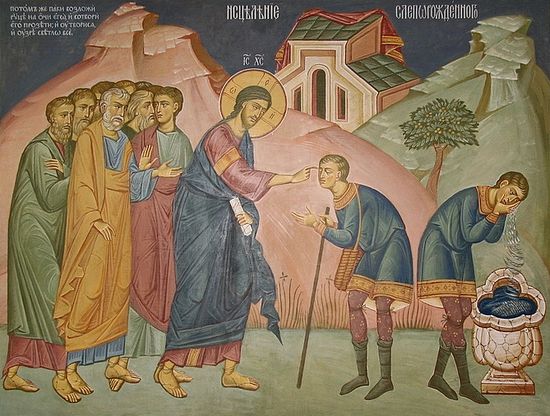
A Blind Woman
She had turned her face up into
a rain of light, and came on smiling.
The light trickled down her forehead
and into her eyes. It ran down
into the neck of her sweatshirt
and wet the white tops of her breasts.
Her brown shoes splashed on
into the light. The moment was like
a circus wagon rolling before her
through puddles of light, a cage on wheels,
and she walked fast behind it,
exuberant, curious, pushing her cane
through the bars, poking and prodding,
while the world cowered back in a corner.
--Ted Kooser (1939- ), from Weather Central, 1994.
Relevant scripture: John 9:1-41
Prayer- In the Morning
This is another day, O Lord.
I know not what it will bring forth,
but make me ready, Lord,
for whatever it may be.
If I am to stand up,
help me to stand bravely.
If I am to sit still,
help me to sit quietly.
If I am to lie low,
help me to do it patiently.
And if I am to do nothing,
let me do it gallantly.
Make these words more than words,
and give me the Spirit of Jesus. Amen.
-- The Book of Common Prayer, "Ministration to the Sick," p. 461, from Church Pension Group of The Episcopal Church
The Man No Longer Blind: Art for Lent 4A
Subscribe to:
Posts (Atom)