What we call the beginning is often the end
And to make an end is to make a beginning.
The end is where we start from. And every phrase
And sentence that is right (where every word is at home,
Taking its place to support the others,
The word neither diffident nor ostentatious,
An easy commerce of the old and the new,
The common word exact without vulgarity,
The formal word precise but not pedantic,
The complete consort dancing together)
Every phrase and every sentence is an end and a beginning,
Every poem an epitaph. And any action
Is a step to the block, to the fire, down the sea’s throat
Or to an illegible stone: and that is where we start.
We die with the dying:
See, they depart, and we go with them.
We are born with the dead:
See, they return, and bring us with them.
The moment of the rose and the moment of the yew-tree
Are of equal duration. A people without history
Is not redeemed from time, for history is a pattern
Of timeless moments. So, while the light fails
On a winter’s afternoon, in a secluded chapel
History is now and England.
With the drawing of this Love and the voice of this Calling
We shall not cease from exploration
And the end of all our exploring
Will be to arrive where we started
And know the place for the first time.
Through the unknown, unremembered gate
When the last of earth left to discover
Is that which was the beginning;
At the source of the longest river
The voice of the hidden waterfall
And the children in the apple-tree
Not known, because not looked for
But heard, half-heard, in the stillness
Between two waves of the sea.
Quick now, here, now, always—
A condition of complete simplicity
(Costing not less than everything)
And all shall be well and
All manner of thing shall be well
When the tongues of flame are in-folded
Into the crowned knot of fire
And the fire and the rose are one.
--T. S. Eliot (1888-1965), from "Little Gidding"
Hymns, Hope, and Inspiration: a collection of poems, songs, hymns, psalms, and prayers
Saturday, April 3, 2021
Station XIV: Jesus is laid in the tomb
Here at the centre everything is still
Before the stir and movement of our grief
Which bears it’s pain with rhythm, ritual,
Beautiful useless gestures of relief.
So they anoint the skin that cannot feel
Soothing his ruined flesh with tender care,
Kissing the wounds they know they cannot heal,
With incense scenting only empty air.
He blesses every love that weeps and grieves
And makes our grief the pangs of a new birth.
The love that’s poured in silence at old graves
Renewing flowers, tending the bare earth,
Is never lost. In him all love is found
And sown with him, a seed in the rich ground.
Before the stir and movement of our grief
Which bears it’s pain with rhythm, ritual,
Beautiful useless gestures of relief.
So they anoint the skin that cannot feel
Soothing his ruined flesh with tender care,
Kissing the wounds they know they cannot heal,
With incense scenting only empty air.
He blesses every love that weeps and grieves
And makes our grief the pangs of a new birth.
The love that’s poured in silence at old graves
Renewing flowers, tending the bare earth,
Is never lost. In him all love is found
And sown with him, a seed in the rich ground.
-- Malcolm Guite (1954- ), Anglican priest, songwriter, theologian, and musician, from his blog.
Image: "Jesus is laid in the tomb," Gwyneth Leech
Sepulchre
No lodging for thee, but a cold hard stone?
So many hearts on earth, and yet not one
Receive thee?
Sure there is room within our hearts good store;
For they can lodge transgressions by the score:
Thousands of toys dwell there, yet out of door
They leave thee.
But that which shows them large, shows them unfit.
Whatever sin did this pure rock commit,
Which holds thee now? Who hath indicted it
Of murder?
Where our hard hearts have took up stones to brain thee,
And missing this, most falsely did arraign thee;
Only these stones in quiet entertain thee,
And order.
And as of old, the law by heav’nly art,
Was writ in stone; so thou, which also art
The letter of the word, find’st no fit heart
To hold thee.
Yet do we still persist as we began,
And so should perish, but that nothing can,
Though it be cold, hard, foul, from loving man
Withhold thee.
-- George Herbert (1593-1633), Welsh- born Anglican priest and poet
Friday, April 2, 2021
A Blackbird Singing
It seems wrong that out of this bird,
Black, bold, a suggestion of dark
Places about it, there yet should come
Such rich music, as though the notes’
Ore were changed to a rare metal
At one touch of that bright bill.
You have heard it often, alone at your desk
In a green April, your mind drawn
Away from its work by sweet disturbance
Of the mild evening outside your room.
A slow singer, but loading each phrase
With histories overtones, love, joy
And grief learned by his dark tribe
In other orchards and passed on
Instinctively as they are now,
But fresh always with new tears.
--R. S. Thomas (1913-2000), Welsh poet and Anglican priest from Collected Poems, 1945-1990.
Good Friday
I deserve this death, | INRI | The two fools died first. |
--Charles Munger, Jr. from Journey with Jesus
The Seven Last Words
1
The story of the end, of the last word
of the end, when told, is a story that never ends.
We tell it and retell it — one word, then another
until it seems that no last word is possible,
that none would be bearable. Thus, when the hero
of the story says to himself, as to someone far away,
‘Forgive them, for they know not what they do,’
we may feel that he is pleading for us, that we are
the secret life of the story and, as long as his plea
is not answered, we shall be spared. So the story
continues. So we continue. And the end, once more,
becomes the next, and the next after that.
2
There is an island in the dark, a dreamt-of place
where the muttering wind shifts over the white lawns
and riffles the leaves of trees, the high trees
that are streaked with gold and line the walkways there;
and those already arrived are happy to be the silken
remains of something they were but cannot recall;
they move to the sound of stars, which is also imagined,
but who cares about that; the polished columns they see
may be no more than shafts of sunlight, but for those
who live on and on in the radiance of their remains
this is of little importance. There is an island
in the dark and you will be there, I promise you, you
shall be with me in paradise, in the single season of being,
in the place of forever, you shall find yourself. And there
the leaves will turn and never fall, there the wind
will sing and be your voice as if for the first time.
3
Someday some one will write a story set
in a place called The Skull, and it will tell,
among other things, of a parting between mother
and son, of how she wandered off, of how he vanished
in air. But before that happens, it will describe
how their faces shone with a feeble light and how
the son was moved to say, ‘Woman, look at your son,’
then to a friend nearby, ‘Son, look at your mother.’
At which point the writer will put down his pen
and imagine that while those words were spoken
something else happened, something unusual like
a purpose revealed, a secret exchanged, a truth
to which they, the mother and son, would be bound,
but what it was no one would know. Not even the writer.
4
These are the days when the sky is filled with
the odor of lilac, when darkness becomes desire,
when there is nothing that does not wish to be born.
These are the days of spring when the fate
of the present is a breezy fullness, when the world’s
great gift for fiction gilds even the dirt we walk on.
On such days we feel we could live forever, yet all
the while we know we cannot. This is the doubleness
in which we dwell. The great master of weather
and everything else, if he wishes, can bring forth
a dark of a different kind, one hidden by darkness
so deep it cannot be seen. No one escapes.
Not even the man who saved others, and believed
he was the chosen son. When the dark came down
even he cried out, ‘Father, father, why have you
forsaken me?’ But to his words no answer came.
5
To be thirsty. To say, ‘I thirst.’ To be given,
instead of water, vinegar, and that to be pressed
from a sponge. To close one’s eyes and see the giant
world that is born each time the eyes are closed.
To see one’s death. To see the darkening clouds
as the tragic cloth of a day of mourning. To be the one
mourned. To open the dictionary of the Beyond and discover
what one suspected, that the only word in it
is nothing. To try to open one’s eyes, but not to be
able to. To feel the mouth burn. To feel the sudden
presence of what, again and again, was not said.
To translate it and have it remain unsaid. To know
at last that nothing is more real than nothing.
6
‘It is finished,’ he said. You could hear him say it,
the words almost a whisper, then not even that,
but an echo so faint it seemed no longer to come
from him, but from elsewhere. This was his moment,
his final moment. “It is finished,” he said into a vastness
that led to an even greater vastness, and yet all of it
within him. He contained it all. That was the miracle,
to be both large and small in the same instant, to be
like us, but more so, then finally to give up the ghost,
which is what happened. And from the storm that swirled
a formal nakedness took shape, the truth of disguise
and the mask of belief were joined forever.
7
Back down these stairs to the same scene,
to the moon, the stars, the night wind. Hours pass
and only the harp off in the distance and the wind
moving through it. And soon the sun’s gray disk,
darkened by clouds, sailing above. And beyond,
as always, the sea of endless transparence, of utmost
calm, a place of constant beginning that has within it
what no eye has seen, what no ear has heard, what no hand
has touched, what has not arisen in the human heart.
To that place, to the keeper of that place, I commit myself.
The story of the end, of the last word
of the end, when told, is a story that never ends.
We tell it and retell it — one word, then another
until it seems that no last word is possible,
that none would be bearable. Thus, when the hero
of the story says to himself, as to someone far away,
‘Forgive them, for they know not what they do,’
we may feel that he is pleading for us, that we are
the secret life of the story and, as long as his plea
is not answered, we shall be spared. So the story
continues. So we continue. And the end, once more,
becomes the next, and the next after that.
2
There is an island in the dark, a dreamt-of place
where the muttering wind shifts over the white lawns
and riffles the leaves of trees, the high trees
that are streaked with gold and line the walkways there;
and those already arrived are happy to be the silken
remains of something they were but cannot recall;
they move to the sound of stars, which is also imagined,
but who cares about that; the polished columns they see
may be no more than shafts of sunlight, but for those
who live on and on in the radiance of their remains
this is of little importance. There is an island
in the dark and you will be there, I promise you, you
shall be with me in paradise, in the single season of being,
in the place of forever, you shall find yourself. And there
the leaves will turn and never fall, there the wind
will sing and be your voice as if for the first time.
3
Someday some one will write a story set
in a place called The Skull, and it will tell,
among other things, of a parting between mother
and son, of how she wandered off, of how he vanished
in air. But before that happens, it will describe
how their faces shone with a feeble light and how
the son was moved to say, ‘Woman, look at your son,’
then to a friend nearby, ‘Son, look at your mother.’
At which point the writer will put down his pen
and imagine that while those words were spoken
something else happened, something unusual like
a purpose revealed, a secret exchanged, a truth
to which they, the mother and son, would be bound,
but what it was no one would know. Not even the writer.
4
These are the days when the sky is filled with
the odor of lilac, when darkness becomes desire,
when there is nothing that does not wish to be born.
These are the days of spring when the fate
of the present is a breezy fullness, when the world’s
great gift for fiction gilds even the dirt we walk on.
On such days we feel we could live forever, yet all
the while we know we cannot. This is the doubleness
in which we dwell. The great master of weather
and everything else, if he wishes, can bring forth
a dark of a different kind, one hidden by darkness
so deep it cannot be seen. No one escapes.
Not even the man who saved others, and believed
he was the chosen son. When the dark came down
even he cried out, ‘Father, father, why have you
forsaken me?’ But to his words no answer came.
5
To be thirsty. To say, ‘I thirst.’ To be given,
instead of water, vinegar, and that to be pressed
from a sponge. To close one’s eyes and see the giant
world that is born each time the eyes are closed.
To see one’s death. To see the darkening clouds
as the tragic cloth of a day of mourning. To be the one
mourned. To open the dictionary of the Beyond and discover
what one suspected, that the only word in it
is nothing. To try to open one’s eyes, but not to be
able to. To feel the mouth burn. To feel the sudden
presence of what, again and again, was not said.
To translate it and have it remain unsaid. To know
at last that nothing is more real than nothing.
6
‘It is finished,’ he said. You could hear him say it,
the words almost a whisper, then not even that,
but an echo so faint it seemed no longer to come
from him, but from elsewhere. This was his moment,
his final moment. “It is finished,” he said into a vastness
that led to an even greater vastness, and yet all of it
within him. He contained it all. That was the miracle,
to be both large and small in the same instant, to be
like us, but more so, then finally to give up the ghost,
which is what happened. And from the storm that swirled
a formal nakedness took shape, the truth of disguise
and the mask of belief were joined forever.
7
Back down these stairs to the same scene,
to the moon, the stars, the night wind. Hours pass
and only the harp off in the distance and the wind
moving through it. And soon the sun’s gray disk,
darkened by clouds, sailing above. And beyond,
as always, the sea of endless transparence, of utmost
calm, a place of constant beginning that has within it
what no eye has seen, what no ear has heard, what no hand
has touched, what has not arisen in the human heart.
To that place, to the keeper of that place, I commit myself.
--Mark Strand (1934-2014) American poet and translator, US Poet Laureate 1990
Thursday, April 1, 2021
Savior
Petulant priests, greedy
centurions, and one million
incensed gestures stand
between your love and me.
Your agape sacrifice
is reduced to colored glass,
vapid penance, and the
tedium of ritual.
Your footprints yet
mark the crest of
billowing seas but
your joy
fades upon the tablets
of ordained prophets.
Visit us again, Savior.
Your children, burdened with
disbelief, blinded by a patina
of wisdom,
carom down this vale of
fear. We cry for you
although we have lost
your name.
centurions, and one million
incensed gestures stand
between your love and me.
Your agape sacrifice
is reduced to colored glass,
vapid penance, and the
tedium of ritual.
Your footprints yet
mark the crest of
billowing seas but
your joy
fades upon the tablets
of ordained prophets.
Visit us again, Savior.
Your children, burdened with
disbelief, blinded by a patina
of wisdom,
carom down this vale of
fear. We cry for you
although we have lost
your name.
-- Maya Angelou (1928-2014), African American autobiographer, poet, humanitarian, and activist
From Blossoms
From blossoms comes
This brown paper bag of peaches
We bought from the boy
At the bend in the road where we turned toward
This brown paper bag of peaches
We bought from the boy
At the bend in the road where we turned toward
Signs painted Peaches.
From laden boughs, from hands,
From sweet fellowship in the bins,
From laden boughs, from hands,
From sweet fellowship in the bins,
Comes nectar at the roadside, succulent
Peaches we devour, dusty skin and all,
Comes the familiar dust of summer, dust we eat.
O, to take what we love inside,
To carry within us an orchard, to eat
Not only the skin, but the shade,
Not only the sugar, but the days, to hold
The fruit in our hands, adore it, then bite into
Comes the familiar dust of summer, dust we eat.
O, to take what we love inside,
To carry within us an orchard, to eat
Not only the skin, but the shade,
Not only the sugar, but the days, to hold
The fruit in our hands, adore it, then bite into
The round jubilance of peach.
There are days we live
As if death were nowhere
In the background; from joy
To joy to joy, from wing to wing,
From blossom to blossom to
Impossible blossom, to sweet impossible blossom.
There are days we live
As if death were nowhere
In the background; from joy
To joy to joy, from wing to wing,
From blossom to blossom to
Impossible blossom, to sweet impossible blossom.
-- Li-Young Lee, from Good Poems, edited by Garrison Keillor
St. Peter
St. Peter once: “Lord, doest Thou wash my feet?”
—Much more I say: Lord, dost Thou stand and knock
At my closed heart more rugged than a rock,
Bolted and barred, for Thy soft touch unmet,
Nor garnished in any wise made sweet?
Owls roost within and dancing satyrs mock.
Lord, I have heard the crowing of the cock
And have not wept: ah, Lord, thou knowest it.
Yet still I hear Thee knocking, still I hear:
“Open to Me, look on Me eye to eye,
That I may wring thy heart and make it whole;
And teach thee love because I hold thee dear
And sup with thee in gladness soul with soul,
And sup with thee in glory by and by.”
At my closed heart more rugged than a rock,
Bolted and barred, for Thy soft touch unmet,
Nor garnished in any wise made sweet?
Owls roost within and dancing satyrs mock.
Lord, I have heard the crowing of the cock
And have not wept: ah, Lord, thou knowest it.
Yet still I hear Thee knocking, still I hear:
“Open to Me, look on Me eye to eye,
That I may wring thy heart and make it whole;
And teach thee love because I hold thee dear
And sup with thee in gladness soul with soul,
And sup with thee in glory by and by.”
-- Christina Rosetti, English poet and supporter of the Oxford movement
Maundy Thursday
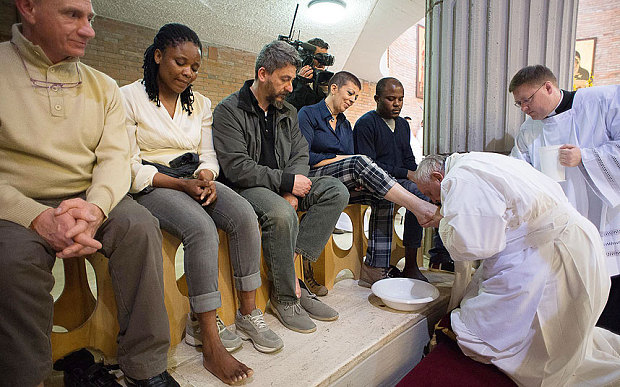
Kneeling on Boston Common it’s the foot
Naked, resting in my lap with clean towel,
Socks, warm water waiting, that tells me
This is what happens after a cold winter
Of deep snow when you’re homeless in
Dirty socks and cracked shoes that don’t fit:
This foot, bloody, swollen, toes deformed,
I wash gently, first one, then the other, and
Never have I felt so close to Jesus, his feet,
Bare, pierced, bloodied, nailed to the wooden
Cross.
Naked, resting in my lap with clean towel,
Socks, warm water waiting, that tells me
This is what happens after a cold winter
Of deep snow when you’re homeless in
Dirty socks and cracked shoes that don’t fit:
This foot, bloody, swollen, toes deformed,
I wash gently, first one, then the other, and
Never have I felt so close to Jesus, his feet,
Bare, pierced, bloodied, nailed to the wooden
Cross.
-- Sarah Rossiter, from the Christian Century, April 8, 2011
Subscribe to:
Posts (Atom)